
TL;DR
- “Brain fog” can describe an overlapping mix of attention, memory, fatigue, and mood-related experiences rather than one uniform medical entity.1
- Sleep, stress, medicines, nutritional problems, injuries, and several other health conditions can affect memory, so the surrounding pattern matters.2
- Semax research discussed here measures stroke rehabilitation, motor-neuron-disease outcomes, brain connectivity, or animal endpoints—not a general brain-fog indication.3
- Sudden confusion with speech trouble, one-sided weakness, vision or balance changes, or a severe headache is an emergency pattern, not ordinary fogginess.4
For Filipino readers balancing work, study, family care, long commutes, and changing sleep, “brain fog” may feel like a useful shortcut. It can name a real and frustrating experience without explaining its cause.1 The practical question is not whether the phrase sounds familiar. It is what changed, when it began, what comes with it, and how much daily life has shifted.5
First, name the experience more precisely
“Brain fog” is not one precise scientific label.1 A 2025 review found that people and researchers use it for overlapping problems involving cognition, fatigue, and affect, meaning mood or emotional state.1 One person may mean slow recall; another may mean poor focus, mental exhaustion, or trouble finding words.1
That variation is why the phrase works better as a starting description than as a finished explanation.6 Useful details include whether the change is sudden or gradual, steady or intermittent, and linked with sleep, illness, stress, or a new medicine.2 Daily impact matters too: forgetting one name differs from repeatedly losing track of tasks, bills, routes, or conversations.5
Semax is named here only as the neutral catalog reference below.3
One phrase can point in several directions
WHO places confusion, forgetfulness, and lack of mental focus or clarity within the cognitive symptoms reported in post COVID-19 condition.7 It also lists memory, concentration, and sleep problems in that context.7 Yet WHO says similar conditions must be considered through medical diagnosis before the post-COVID label fits.8
The National Institute on Aging gives a wider map for memory changes.2 Its list includes sleep problems, medicine side effects, depression or anxiety, head injury, low vitamin B12, organ problems, substance misuse, and conditions affecting the brain.2 The point is not to pick the scariest item from a list.2 It is to avoid treating one vague phrase as proof of one cause.1
The cross-condition review reaches a similar conclusion.6 Shared wording may reflect language, overlapping cognitive problems, and noncognitive factors more than one shared brain mechanism.6
Timeline and function make the description useful
A useful account begins with time.5 Note when the change started, whether it followed an illness or injury, and whether it comes in waves.2 Then name the task: reading a report twice, missing steps in a familiar process, losing a word during conversation, or struggling to switch between tasks.1
Function adds scale.5 The National Institute on Aging separates occasional forgetfulness from problems that interfere with ordinary activities.5 WHO likewise notes that cognitive symptoms in post COVID-19 condition can affect work and household tasks.8 For a Filipino student, employee, parent, caregiver, or older adult, that may mean describing the missed action rather than saying only “lutang” or “foggy.”
Duration also matters.5 The NIH guidance advises discussing memory problems that persist for weeks with a doctor.5 That conversation can connect the symptom pattern with health history instead of forcing the phrase into a self-selected diagnosis.2
Some patterns should not wait
“Brain fog” usually sounds gradual and blurry, but sudden confusion belongs to a different safety frame.4 CDC lists sudden confusion, trouble speaking, or difficulty understanding speech among stroke warning signs.4 It places them beside sudden one-sided weakness or numbness, vision trouble, balance trouble, and a severe headache without a known cause.4
That cluster calls for immediate emergency help.4 A person should not wait for the feeling to clear or spend time comparing cognitive products when those signs appear.4 The same caution applies when sudden speech or awareness changes arrive with weakness, vision loss, or severe head pain.4
This does not mean every tired or distracted moment signals a stroke.4 It means speed and accompanying signs change the category of concern.4 “What happened, how quickly, and what else changed?” is safer than treating all mental cloudiness as one experience.4
What the human Semax records measured
One human Semax study involved 110 people after ischemic stroke.9 Researchers divided them by early or late rehabilitation and by whether Semax was included.9 They measured plasma BDNF, motor performance, and Barthel Index scores, which track independence in daily activities.9 The abstract reported changes in those stroke-rehabilitation measures.9
Another record involved 27 people with motor neuron disease.10 Its open-label, sequential-group design measured electromyography, functional ratings, and quality of life.10 The abstract reported no influence on denervation or clinical-estimate dynamics.10 It also reported a quality-of-life change attributed to emotional state and motivation.10
These details deserve their full labels.3 Stroke rehabilitation and motor-neuron-disease measures are not synonyms for an everyday complaint of poor focus.3 A disease-specific result cannot be detached from its participants and endpoints, then renamed as a general peptide indication.3
Imaging and animal findings answer narrower questions
A short-term imaging experiment studied 52 healthy participants.11 Researchers compared resting-state functional connectivity before and at five and 20 minutes after Semax, Selank, or placebo.11 They reported connectivity differences involving predefined regions.11 Functional connectivity describes a relationship in brain-signal patterns; it is not the same measurement as clearer thinking during work or study.11
Animal research asks other questions.12 One Selank study used nine-month-old rats, including an ethanol-exposure model, and measured object recognition and brain BDNF.12 A Semax study used transgenic Alzheimer’s-model mice, behavioral tasks, and amyloid measurements in brain tissue.12
Those findings remain rat and mouse results under specific laboratory conditions.12 They do not establish matching experiences in people.12 Model, task, tissue measure, and species must travel with the result whenever it is summarized.12
Selank is named here only as the neutral catalog reference below.
Why a mechanism is not an indication
A mechanism asks how a biological process might work.11 An imaging measure asks whether signal relationships changed under a protocol.11 A behavioral task in a rodent asks how that animal performed under defined laboratory conditions.12 An indication is a different claim because it connects a defined intervention to a defined clinical use.3
The brain-fog review itself warns that one shared biology should not be assumed from shared language.6 The Semax and Selank records here span stroke rehabilitation, motor neuron disease, healthy-volunteer imaging, and animal models.3 Their variety does not combine into one broad result.3
This distinction protects the useful parts of the research.3 The stroke study can remain a stroke study.9 The imaging result can remain an imaging result.11 The animal work can remain evidence about its animal models.12 None needs an inflated “brain fog” headline to be worth reading carefully.3
Read a cognitive claim in five passes
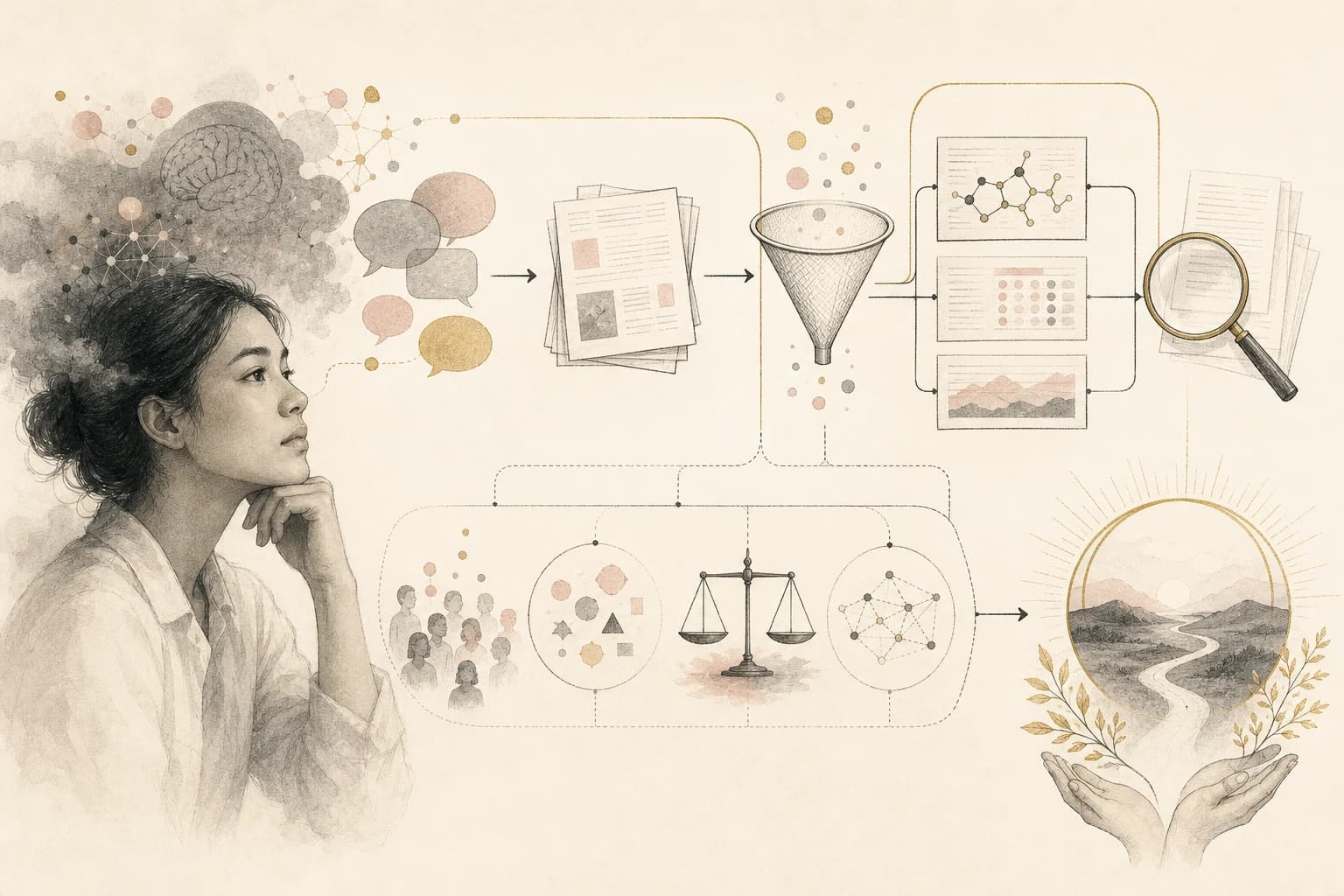
First, replace the catchy label with the exact complaint: attention, recall, word finding, speed, fatigue, or task switching.1 Second, check timing and daily function, since persistence and interference help distinguish a passing lapse from a concern worth discussing.5
Third, look for context such as sleep change, illness, injury, mood, medicine use, nutrition, or substance use.2 Fourth, scan for sudden neurological warning signs before settling into ordinary research reading.4 Fifth, inspect the study endpoint.3
Was the outcome a participant-reported symptom, a daily-function scale, a motor score, an fMRI signal, a blood marker, or an animal task?9 These measures are not interchangeable.3 A result should keep its population, model, comparator, and time frame.3 That habit makes dense peptide research more understandable without turning curiosity into a conclusion the study never tested.3
Bottom line
“Brain fog” can be a sincere description of mental slowness, poor focus, fatigue, or forgetfulness, but it does not supply one cause.1 Its meaning becomes clearer through timing, accompanying symptoms, and effects on daily life.5 Sudden confusion with stroke warning signs needs immediate emergency attention.4
Semax and Selank studies can still be read with interest when their boundaries stay visible.3 The human records discussed here concern stroke, motor neuron disease, or short-term brain imaging.3 The cognitive animal findings remain tied to rats and transgenic mice.12 None of those endpoints turns “brain fog” into a peptide indication.3 Precision is not dismissal; it is how a vague symptom becomes a useful conversation.1
This article is educational research context, not medical advice. Catalog links are neutral references and do not imply a treatment or human-use recommendation.
Frequently asked questions
Is brain fog a diagnosis?
The phrase has been used as a symptom, a syndrome, and a nonspecific term across different conditions.1 It may describe attention, memory, fatigue, or mood-linked experiences rather than one uniform entity.1 A useful next step is to describe the exact change, its timing, and its effect on daily tasks.5
What details should I note?
Record when the change began, whether it comes and goes, and which tasks became harder.5 Include sleep changes, recent illness or injury, mood, medicines, nutrition, and substance use because these can shape memory complaints.2 Specific examples give a clinician more context than the phrase “brain fog” alone.2
When is confusion an emergency?
Sudden confusion or speech trouble needs an emergency frame when it appears with one-sided weakness, vision trouble, balance loss, or a severe unexplained headache.4 CDC identifies these as stroke warning signs and calls for immediate emergency help.4 This pattern differs from ordinary gradual tiredness or distraction.4
What did the Semax stroke study assess?
The study followed 110 people after ischemic stroke in early and late rehabilitation groups.9 It assessed plasma BDNF, motor performance, and Barthel Index function.9 Those are stroke-rehabilitation endpoints, so the record should not be rewritten as a general result for anyone describing poor focus.3
Did the imaging study measure clearer thinking?
The 52-person experiment measured resting-state functional connectivity minutes after Semax, Selank, or placebo.11 Its abstract reported differences in signal relationships involving predefined regions.11 That imaging endpoint is distinct from measuring symptom relief, classroom performance, workplace function, or a diagnosed cognitive disorder.11
What do the animal studies add?
The Selank record measured object recognition and BDNF in rats, including an ethanol-exposure model.12 The Semax record measured behavior and amyloid in transgenic Alzheimer’s-model mice.12 These experiments add model-specific findings, but they do not establish the same cognitive experience or outcome in people.12
Sources
Footnotes
-
Defining brain fog across medical conditions.. Review of how brain fog has been defined and measured across more than a dozen chronic diseases. The phrase does not identify one shared biological cause or one uniform cognitive profile. ↩ ↩2 ↩3 ↩4 ↩5 ↩6 ↩7 ↩8 ↩9 ↩10 ↩11 ↩12
-
Memory Problems, Forgetfulness, and Aging. NIH public guidance on memory problems and forgetfulness. The list illustrates possible contexts and is not a self-diagnosis checklist. ↩ ↩2 ↩3 ↩4 ↩5 ↩6 ↩7 ↩8 ↩9 ↩10
-
Defining brain fog across medical conditions.; [The efficacy of semax in the tretament of patients at different stages of ischemic stroke].; [The study of chronic partial denervation and quality of life in patients with motor neuron disease treated with semax].; Functional Connectomic Approach to Studying Selank and Semax Effects.; Selank, Peptide Analogue of Tuftsin, Protects Against Ethanol-Induced Memory Impairment by Regulating of BDNF Content in the Hippocampus and Prefrontal Cortex in Rats.; The Potential of the Peptide Drug Semax and Its Derivative for Correcting Pathological Impairments in the Animal Model of Alzheimer's Disease.. Endpoint comparison between a cross-condition brain-fog review and specific human and animal Semax or Selank studies. This claim limits interpretation of these specific results and does not infer that other records do not exist. ↩ ↩2 ↩3 ↩4 ↩5 ↩6 ↩7 ↩8 ↩9 ↩10 ↩11 ↩12 ↩13 ↩14 ↩15 ↩16 ↩17 ↩18
-
Signs and Symptoms of Stroke. CDC public guidance on stroke signs and emergency response. A vague or gradual concentration complaint is not equivalent to this sudden warning-sign pattern. ↩ ↩2 ↩3 ↩4 ↩5 ↩6 ↩7 ↩8 ↩9 ↩10 ↩11 ↩12 ↩13 ↩14 ↩15
-
Memory Problems, Forgetfulness, and Aging. NIH public guidance comparing mild forgetfulness with more serious functional problems. A change in daily function is a reason for evaluation, not proof of a particular diagnosis. ↩ ↩2 ↩3 ↩4 ↩5 ↩6 ↩7 ↩8 ↩9 ↩10 ↩11
-
Defining brain fog across medical conditions.. Cross-condition conceptual review of definitions and objective correlates. This is the authors' synthesis of the reviewed literature, not a diagnostic rule for an individual. ↩ ↩2 ↩3 ↩4
-
Coronavirus disease (COVID-19): Post COVID-19 condition. WHO public guidance on symptoms of post COVID-19 condition. These symptoms are not specific to post COVID-19 condition, and WHO says similar conditions must be ruled out through medical diagnosis. ↩ ↩2
-
Coronavirus disease (COVID-19): Post COVID-19 condition. WHO description of daily-function effects and diagnostic context for post COVID-19 condition. This guidance concerns post COVID-19 condition and does not assign every concentration complaint to that condition. ↩ ↩2
-
[The efficacy of semax in the tretament of patients at different stages of ischemic stroke].. Human clinical study in post-stroke rehabilitation, with Semax and non-Semax subgroups. The population had ischemic stroke, and the listed endpoints were not a general brain-fog diagnosis or symptom scale. ↩ ↩2 ↩3 ↩4 ↩5 ↩6 ↩7 ↩8
-
[The study of chronic partial denervation and quality of life in patients with motor neuron disease treated with semax].. Open-label human study in sequential groups of people with motor neuron disease. The abstract's mixed endpoint pattern belongs to this disease-specific, open-label setting. ↩ ↩2 ↩3 ↩4
-
Functional Connectomic Approach to Studying Selank and Semax Effects.. Short-term resting-state fMRI experiment in healthy participants. A connectivity difference is an imaging measurement, not a demonstrated change in a brain-fog symptom or everyday function. ↩ ↩2 ↩3 ↩4 ↩5 ↩6 ↩7 ↩8 ↩9 ↩10
-
Selank, Peptide Analogue of Tuftsin, Protects Against Ethanol-Induced Memory Impairment by Regulating of BDNF Content in the Hippocampus and Prefrontal Cortex in Rats.; The Potential of the Peptide Drug Semax and Its Derivative for Correcting Pathological Impairments in the Animal Model of Alzheimer's Disease.. Two separate animal studies using different species, disease models, behavioral tests, and tissue measurements. These animal outcomes do not establish matching symptom or functional outcomes in people. ↩ ↩2 ↩3 ↩4 ↩5 ↩6 ↩7 ↩8 ↩9 ↩10 ↩11 ↩12