Quick answer
Bodybuilding stories about ipamorelin are not confirmed by the reported human trials. One volunteer study measured a brief episode of growth-hormone release. Another randomized trial studied bowel recovery after surgery and found no significant efficacy difference from placebo.
Neither trial tested muscle gain, fat loss, gym recovery, sleep, or athletic performance. A ferret study and isolated-tissue experiments answer still different questions. Filipino readers can listen to an anecdote without treating it as proof: first identify the claimed outcome, then check whether a controlled human study measured it in a comparable population.123
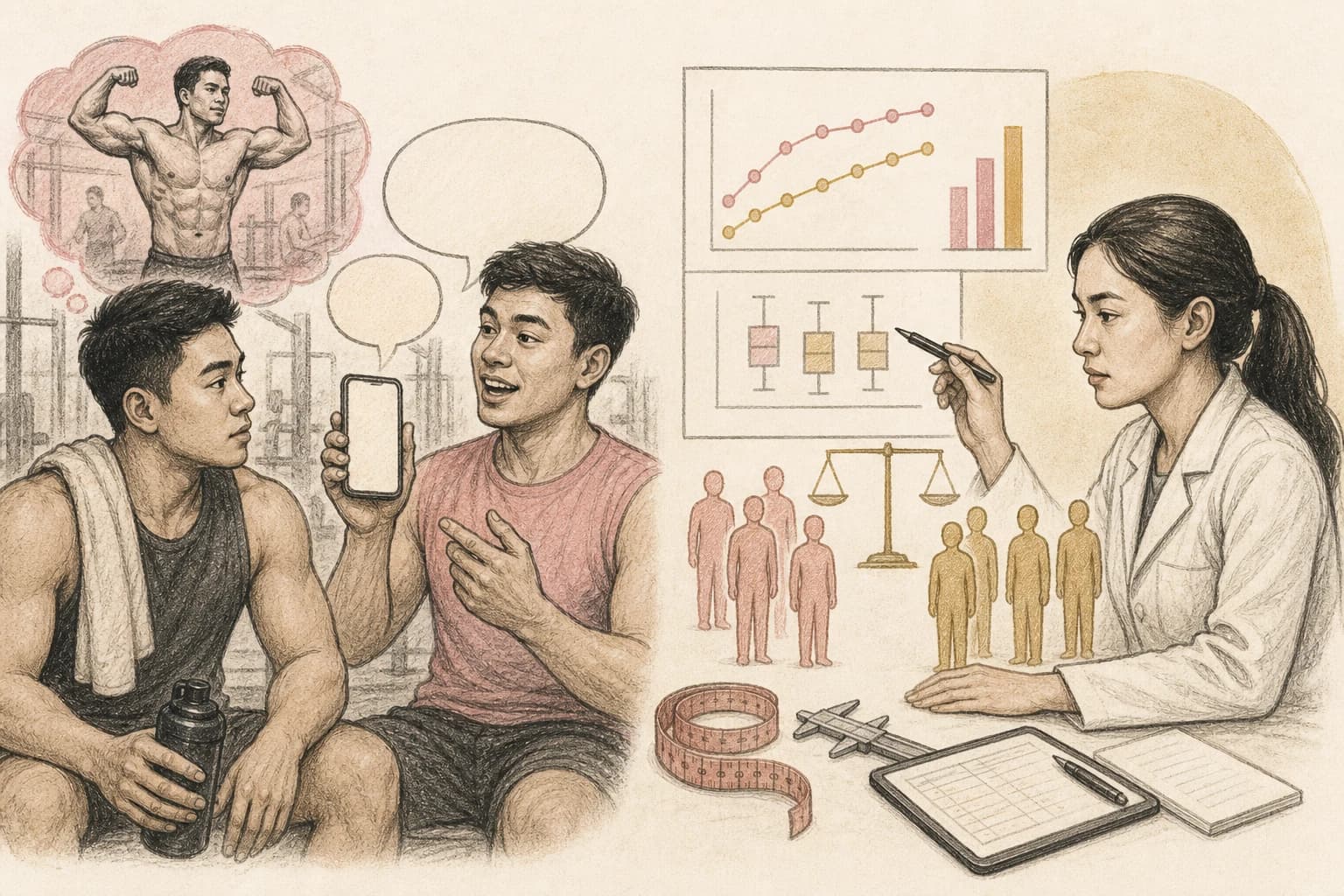
What makes a gym anecdote appealing?
A personal story is concrete. Someone names a compound, describes a change, and offers a simple timeline. That can feel more relevant than a technical paper.
The problem is not necessarily dishonesty. One person cannot separate the compound from training changes, diet, sleep, expectation, measurement error, natural variation, or other products.
Bodybuilding progress also moves unevenly. Strength can rise through technique, glycogen, confidence, and practice without proving new muscle tissue. Scale weight can move through water, food, and sodium without showing a fat change.
An anecdote has no randomized comparison group and usually no predefined outcome. The person knows what they took, which can influence both behavior and perception.
The story can suggest a question worth studying. It cannot estimate how often an effect occurs, how large it is, or whether the compound caused it.
Readers researching Ipamorelin can view its live catalog details below. The listing identifies the catalog item and is separate from the evidence discussed here.
What did the healthy-volunteer study find?
A pharmacokinetic and pharmacodynamic study gave ipamorelin to healthy male volunteers and measured the compound alongside growth hormone. Researchers observed one episode of growth-hormone release followed by decline.1
This shows a biological response under the study conditions. It does not show that participants built muscle, lost fat, lifted more, recovered faster, or slept better.
Pharmacokinetic studies track what the body does to a compound over time. Pharmacodynamic studies track what the compound does to a measured biological signal. Both can be essential early research.
Neither label guarantees a patient-centered or performance outcome. A hormone curve can support the mechanism while leaving the practical gym claims unanswered.
The strongest accurate sentence is therefore modest: identified ipamorelin triggered a measured GH episode in healthy male volunteers. Adding “which improves bodybuilding results” would go beyond the paper.1
What happened in the randomized human trial?
A multicenter, double-blind, placebo-controlled phase 2 study enrolled adults undergoing bowel resection. Researchers tested whether ipamorelin improved postoperative gastrointestinal recovery.2
The trial reported no significant difference from placebo in its key or secondary efficacy analyses. Its main endpoint concerned tolerance of a standardized solid meal after surgery.2
This is genuine human clinical evidence, but it is not a bodybuilding test. Surgical inpatients, bowel recovery, and a hospital protocol differ sharply from healthy gym users and physique outcomes.
The negative result should not be exaggerated either. It does not prove that ipamorelin has no biological activity, because the volunteer study measured a hormone response. It shows that activity did not translate into the tested postoperative efficacy result.
Together, the two human reports form a useful boundary: hormone pharmacology was observed, while one separate clinical outcome was not significantly improved. Muscle and fat outcomes remain untested in these papers.3
Do the ferret findings support weight claims?
A ferret experiment examined ipamorelin during cisplatin-related illness. The compound was associated with less weight loss during a delayed phase, while acute and delayed emesis did not change after peripheral delivery.4
This was not a fat-loss result. It involved prevention of illness-associated weight loss in animals, which points in the opposite direction from many slimming claims.
Species and disease context matter. A ferret receiving cisplatin is not a healthy person following a resistance-training program. The outcome cannot be reassigned to bodybuilding.
The same paper included experiments using isolated ferret ileum. Those tissue measurements are distinct from the whole-animal observation and even further removed from a human performance outcome.5
Animal and tissue research can reveal mechanisms. They do not become human trials because the compound name is the same.
Readers comparing this topic with CJC-1295 with DAC can view its live catalog details below. It is a separate catalog reference, not a suggested combination.
Why are online stacks another evidence problem?
A critical review of peptide use in sport says clinical evidence for performance use is limited. It contrasts controlled therapeutic research with combined or high-exposure practices described in bodybuilding.67
A stack is a new intervention. If someone combines ipamorelin with CJC-1295, diet changes, supplements, and a new training block, no single component can be isolated from the anecdote.
Even when each ingredient has some research, their combination may not have controlled human evidence. Separate pharmacology papers cannot be added together like ingredients in a recipe.
Online communities can also filter which stories remain visible. Dramatic reports receive attention, while neutral experiences, dropouts, and adverse outcomes may be less likely to be posted or shared.
Commercial incentives add another filter. Affiliate links, coaching services, and discount codes can reward certainty and excitement, even when the writer genuinely believes the experience being described.
This selection creates the impression of consistency without a defined denominator. Readers do not know how many people tried the product, which products were authentic, or how many saw no change.
How can Filipino readers test a claim before sharing it?
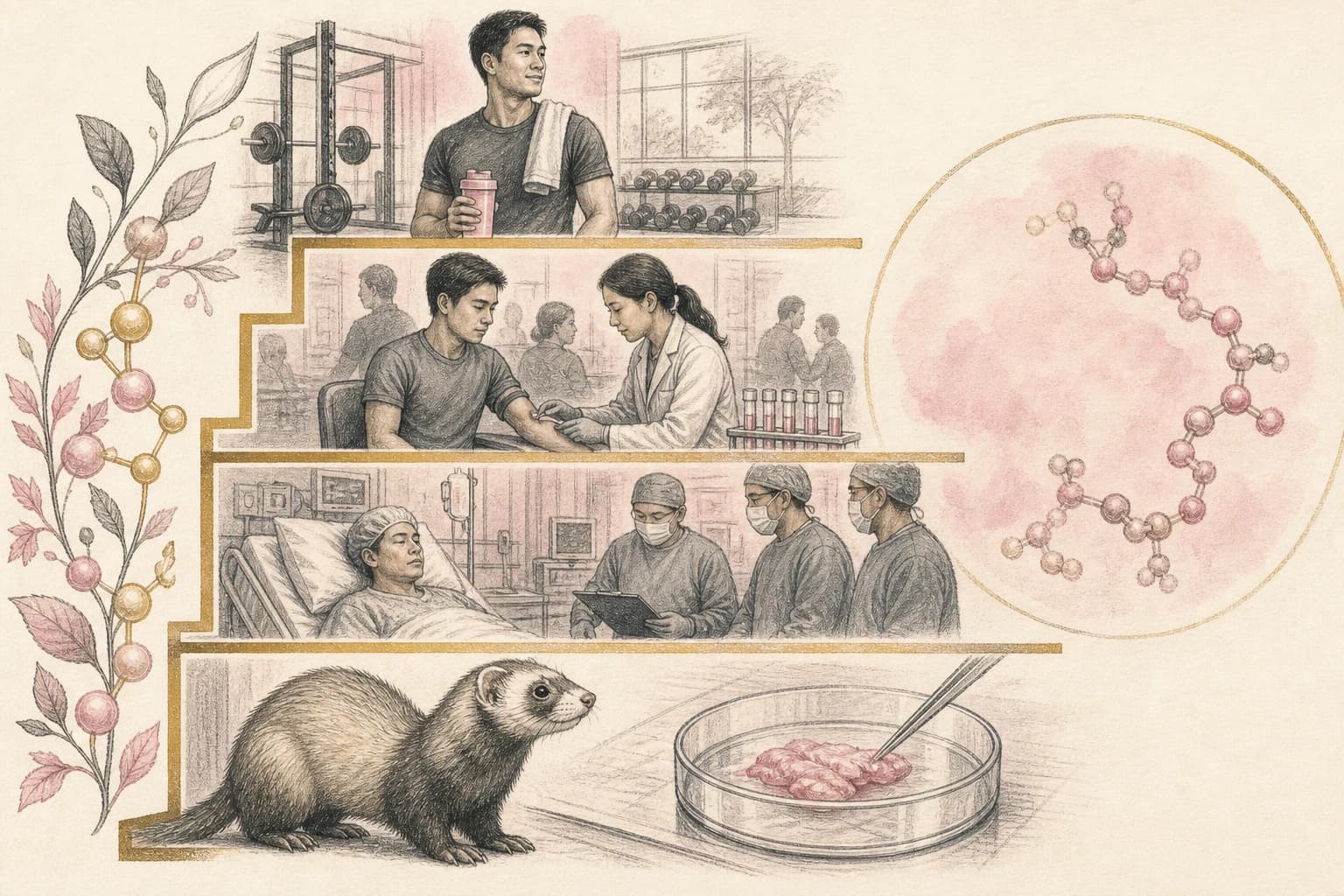
Write the claim as a measurable sentence. “Ipamorelin builds muscle” should lead to controlled human data measuring muscle mass or function—not a GH curve.
Match the population. A finding in surgical inpatients or ferrets should not be described as a result in healthy Filipino gym users.24
Match the intervention. Evidence for a named compound does not verify a seller’s product, and evidence for one ingredient does not prove a multi-compound stack.
Look for the comparator and outcome timing. Before-and-after photos without standardized lighting, posture, hydration, and a control group are vulnerable to ordinary variation.
Finally, preserve uncertainty. “I noticed” can be an honest personal report. “This proves” requires controlled evidence capable of ruling out competing explanations.
Bottom line
Ipamorelin anecdotes often promise muscle, fat-loss, sleep, or recovery effects that the cited human research did not test. A volunteer study documented a growth-hormone episode, while a randomized postoperative trial found no significant efficacy advantage for bowel recovery.
Animal and isolated-tissue findings concern a cisplatin-related ferret model, not bodybuilding. Reviews also describe limited clinical evidence for performance use and a mismatch between controlled research and online stacking practices. Filipino readers should treat personal stories as questions, then demand a comparable human trial before treating the claimed gym outcome as established.
Frequently asked questions
Has ipamorelin been studied in humans?
Yes. Human research measured hormone pharmacology and postoperative bowel recovery.12
Did those studies prove muscle gain or fat loss?
No. They did not measure bodybuilding outcomes.3
Was the postoperative trial positive?
No significant difference appeared in its key or secondary efficacy analyses.2
Does the ferret weight result support human fat loss?
No. It involved illness-associated weight loss in an animal model, not fat loss in people.4
Do the cards recommend an ipamorelin and CJC-1295 stack?
No. They are separate catalog references and do not recommend combining products, amount guidance, treatment, or human use.
Sources
Footnotes
-
Pharmacokinetic-pharmacodynamic modeling of ipamorelin, a growth hormone releasing peptide, in human volunteers.. Human pharmacokinetic-pharmacodynamic study in healthy male volunteers. The report did not measure bodybuilding, muscle, fat-loss, or athletic-performance outcomes. ↩ ↩2 ↩3 ↩4
-
Prospective, randomized, controlled, proof-of-concept study of the Ghrelin mimetic ipamorelin for the management of postoperative ileus in bowel resection patients.. Multicenter, double-blind, placebo-controlled study in surgical inpatients. Its main question concerned postoperative bowel recovery, not bodybuilding. ↩ ↩2 ↩3 ↩4 ↩5 ↩6
-
Prospective, randomized, controlled, proof-of-concept study of the Ghrelin mimetic ipamorelin for the management of postoperative ileus in bowel resection patients.; Pharmacokinetic-pharmacodynamic modeling of ipamorelin, a growth hormone releasing peptide, in human volunteers.. Human volunteer and surgical inpatient research. A result must remain tied to the population and outcome that researchers tested. ↩ ↩2 ↩3
-
The growth hormone secretagogue receptor 1a agonists, anamorelin and ipamorelin, inhibit cisplatin-induced weight loss in ferrets: Anamorelin also exhibits anti-emetic effects via a central mechanism.. Animal experiment in a cisplatin-related ferret model. This is animal evidence in a specific model, not a human bodybuilding finding. ↩ ↩2 ↩3
-
The growth hormone secretagogue receptor 1a agonists, anamorelin and ipamorelin, inhibit cisplatin-induced weight loss in ferrets: Anamorelin also exhibits anti-emetic effects via a central mechanism.. Laboratory experiment using isolated ferret tissue. A laboratory measurement cannot establish a human outcome. ↩
-
A new era of doping? Use of peptide and peptide-analog drugs in recreational and professional sport and bodybuilding: a critical review.. Critical review of peptide and peptide-analogue use in recreational and professional sport. A review provides context; it does not replace a controlled study of a defined bodybuilding outcome. ↩
-
A new era of doping? Use of peptide and peptide-analog drugs in recreational and professional sport and bodybuilding: a critical review.. Critical review comparing published research settings with bodybuilding contexts. Different settings, populations, and outcomes cannot be treated as interchangeable. ↩