
Quick answer
BPC-157 is a synthetic peptide made of 15 amino acids and is also called Body Protection Compound 157 or a gastric pentadecapeptide. “Pentadecapeptide” describes length: penta-deca means fifteen. “Body Protection Compound” sounds like an outcome, but a name is not evidence of whole-body protection. Human studies in this record are tiny and condition-specific, while a sports-medicine review found that nearly all included orthopedic evidence was preclinical. The safest reading separates chemistry, nickname, species, and measured outcome.1234
What does BPC-157 mean?
BPC-157 is a synthetic peptide containing 15 amino acids.1 Peptides are short chains built from amino-acid units.
The number distinguishes the research name. It does not indicate experimental amount, purity, approval, or the number of proven benefits.
“Pentadecapeptide” is a structural description. “Penta” and “deca” together refer to fifteen, matching the chain length.
The word “gastric” appears in descriptions of the research history and association with stomach-derived material. It does not prove that every product came from the stomach.
These labels help identify the topic in papers. They should not be converted into marketing promises.
Search aliases can also merge different contexts. A paper may use BPC 157 without a hyphen, while a seller uses the full nickname. Readers should match the underlying molecule and source rather than assuming every phrase represents verified material.
Readers researching BPC-157 can view its live catalog details below. The listing identifies the catalog item and is separate from the evidence discussed here.
Why is “Body Protection Compound” misleading?
The phrase sounds as if protection across the body has already been demonstrated. It is a name, not a randomized clinical conclusion.
Names can shape expectations before evidence is read, which makes careful translation essential.
Broad words hide the endpoint. Protection could mean a laboratory marker, tissue appearance in an animal, symptom report, or fewer clinical events.
They also hide the population and duration. A result in rats after an induced injury cannot become permanent protection in healthy people.
Good writing improves BPC as an alias and immediately explains what study actually measured.
The same caution applies to “healing peptide.” Healing covers many tissues and patient outcomes that require separate human trials.
A compound can have an ambitious nickname and a narrow evidence base at the same time.
What did the two-person safety pilot show?
A pilot study gave intravenous BPC-157 to two healthy adults.2
It reported that the intervention was well tolerated and found no measurable effects on the tested heart, liver, kidney, thyroid, or blood-glucose biomarkers.2
Two participants are far too few to estimate uncommon side effects or support a broad safety claim. The study itself requires confirmation in larger trials.2
The result is also tied to a monitored intravenous protocol. It cannot establish the identity or safety of other products and routes.
“No measured change” only applies to the chosen biomarkers and observation period. It does not mean every possible harm was excluded.
The pilot is human evidence, but its scale makes it an early signal rather than a safety verdict.
A two-person study has almost no ability to estimate an event occurring in one of hundreds or thousands of exposures. It can document that those two monitored participants completed the protocol, which is useful but extremely narrow.
What did the bladder-symptom pilot report?
An open-label pilot included 12 women with interstitial cystitis who had not responded to pentosan polysulfate.3
After a single procedure involving BPC-157, 10 reported complete symptom resolution and two reported 80 percent improvement. No adverse events were reported.3
The result is positive and condition-specific. The study had no placebo group, so expectations, natural symptom changes, procedure effects, and other factors cannot be separated.3
Twelve participants also provide limited precision. A larger controlled study could produce a different estimate.
Open-label design means participants and researchers knew what was given. Symptom reporting can be influenced by expectations, attention, concurrent care, or ordinary fluctuation. A control group helps estimate how much change would have occurred without the intervention.
This finding should not become a claim about tendons, muscle, gut healing, or general protection. Those are different outcomes.
Readers comparing this topic with TB-500 can view its live catalog details below. It is a separate catalog reference, not a suggested combination.
How much orthopedic human evidence exists?
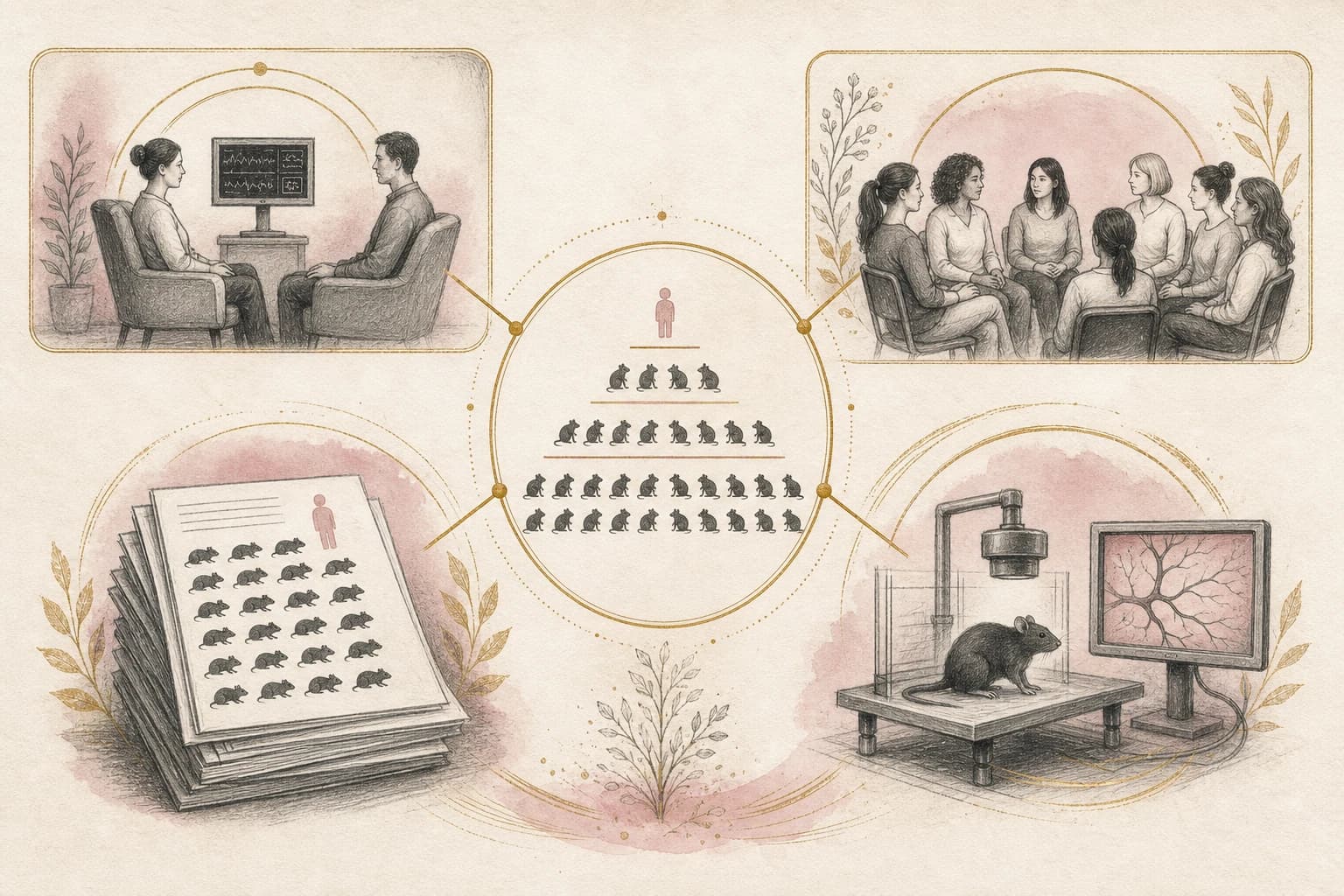
A systematic review of BPC-157 in orthopedic sports medicine included 36 studies.4
Only one was a clinical human study; the other 35 were preclinical animal research.4
That evidence distribution matters more than the total study count. “Thirty-six studies” sounds substantial until the species are shown.
Animal models can explore tendon, muscle, bone, blood flow, and inflammation under controlled conditions. They cannot establish recovery time or safe use in athletes.
Translation requires more than showing that a pathway exists in both species. Exposure, injury model, outcome scale, anatomy, and follow-up must all fit the human question. A rat biomarker can guide a trial without becoming its conclusion.
A rat lower-limb ischemia-reperfusion study reported reduced oxidative-stress and inflammation markers and partial restoration of a blood-vessel growth factor.5
The result belongs to rats with an experimentally induced injury. It is not evidence of human whole-body protection.5
What should Filipino readers verify?
The Philippine FDA Verification Portal separates licensed establishments from registered or notified health products.6
Search the exact product, manufacturer, form, and current record. A seller’s business entry cannot verify an item’s contents.
WHO notes that some falsified medical products can closely resemble genuine ones and may require quality-control analysis.7
Research names are easy to copy onto a label. That label does not prove amino-acid sequence, purity, sterility, or equivalence to study material.
The source, study context, molecule identity, and current local record should remain visible in every conclusion.8
How can a BPC-157 claim be decoded?
Replace the nickname with the exact molecule. “Body protection” becomes “BPC-157, a synthetic 15-amino-acid peptide.”1
Find the species and sample size. Two people, 12 people, and a rat model answer very different questions.235
Name the endpoint. A biomarker, symptom report, and tissue finding should not be treated as interchangeable.
Check for a comparator and blinding. An open-label pilot without placebo can identify a signal but cannot isolate cause confidently.3
Finally, verify the product itself. A paper about BPC-157 cannot authenticate a catalog or marketplace item.67
Bottom line
BPC-157’s aliases explain its research identity: a synthetic peptide with 15 amino acids, sometimes called a gastric pentadecapeptide or Body Protection Compound. None of those names proves broad protection or healing.
The human evidence here includes a two-person safety pilot and a 12-person open-label bladder-symptom pilot. Orthopedic literature remains overwhelmingly preclinical, including rat injury research. Filipino readers should keep the nickname, measured endpoint, species, sample size, and exact product identity separate. A memorable name can start a search, but only well-designed human studies can establish a reliable human claim.
Frequently asked questions
What does pentadecapeptide mean?
It means a peptide made of 15 amino acids.1
Does “Body Protection Compound” prove whole-body protection?
No. It is an alias, not a clinical outcome.
Was the human safety pilot large?
No. It included only two healthy adults.2
Was the interstitial-cystitis pilot placebo controlled?
No. It was an open-label study of 12 women.3
Is most orthopedic evidence human?
No. One review found one human clinical study and 35 preclinical animal studies.4
Sources
Footnotes
-
From Regeneration to Analgesia: The Role of BPC-157 in Tissue Repair and Pain Management.. Review ↩ ↩2 ↩3 ↩4
-
Safety of Intravenous Infusion of BPC157 in Humans: A Pilot Study.. Pilot study (n=2) This was a very small pilot study, and the results need to be confirmed in larger trials. ↩ ↩2 ↩3 ↩4 ↩5 ↩6
-
Effect of BPC-157 on Symptoms in Patients with Interstitial Cystitis: A Pilot Study.. Pilot study (n=12) This was an open-label pilot study without a placebo control group. ↩ ↩2 ↩3 ↩4 ↩5 ↩6 ↩7
-
Emerging Use of BPC-157 in Orthopaedic Sports Medicine: A Systematic Review.. Systematic review ↩ ↩2 ↩3 ↩4
-
Protective effects of BPC 157 in rats with experimentally induced lower extremity ischemia-reperfusion injury.. Animal study (rats) This is an animal study; results may not translate to humans. ↩ ↩2 ↩3
-
Philippine FDA Verification Portal; FDA Advisory No. 2023-2238: Utilization of the FDA Verification Portal. Official Philippine regulatory verification service. A portal record applies to the exact product or establishment named in that record. ↩ ↩2
-
WHO laboratory analysis of suspected falsified medical products; WHO laboratory testing for health-product regulation. WHO guidance on suspected falsified medical products and regulatory laboratory testing. Appearance alone cannot authenticate a product or establish a research outcome. ↩ ↩2
-
From Regeneration to Analgesia: The Role of BPC-157 in Tissue Repair and Pain Management.; Safety of Intravenous Infusion of BPC157 in Humans: A Pilot Study.; Effect of BPC-157 on Symptoms in Patients with Interstitial Cystitis: A Pilot Study.; Philippine FDA Verification Portal; FDA Advisory No. 2023-2238: Utilization of the FDA Verification Portal. Editorial synthesis of the canonical research records and Philippine verification sources. This synthesis is educational and is not personal medical advice or a product recommendation. ↩