
TL;DR
- Retatrutide combines signals at three hormone receptors in one molecule: GIP, GLP-1, and glucagon. That design makes it a leading example of research moving beyond single-pathway medicines.1
- A phase 3 trial in adults with type 2 diabetes reported better blood-sugar measures and lower body weight versus placebo, with gastrointestinal events occurring most often.2
- Research also covers appetite, body composition, liver fat, blood markers, kidney biology, and fat tissue, but much of this evidence remains exploratory, indirect, or early-stage.3
- The broader pipeline is not one race. It includes multi-receptor agents, amylin combinations, and oral small-molecule approaches, each with different questions to answer.4
For Filipino readers, the buzz around metabolic medicines can make every laboratory headline sound like a finished medical breakthrough. It is not. The useful question is narrower. What has actually been tested in people? What remains a signal from animals, cells, or study plans?4
This article is educational research context, not medical advice. Catalog links are neutral references and do not imply a treatment or human-use recommendation.
Why researchers are moving beyond one signal
Semaglutide helped establish GLP-1 biology as a major direction in metabolic medicine research.4 The next wave asks whether one molecule can coordinate several hormone signals at once.4 Retatrutide is designed to activate receptors for GIP, GLP-1, and glucagon.1 These receptors help researchers study connected processes involving appetite, glucose handling, energy storage, and energy use.4
That three-part design is scientifically interesting, but design alone proves nothing about outcomes.1 A receptor map cannot answer how people feel, what adverse events occur, or whether changes last.2 Those questions require controlled human trials and careful follow-up.2 Retatrutide therefore offers a useful case study in reading the evidence ladder.1 Mechanism comes first, measured human outcomes come next, and longer-term questions remain open.1
Retatrutide is the primary research subject here, and the card below is a neutral catalog reference.1
What the strongest human trial shows
The clearest evidence in this collection comes from a 40-week, randomized phase 3 trial.2 It included 537 adults with type 2 diabetes inadequately controlled by diet and exercise.2 Participants received retatrutide or placebo under double-blind conditions.2
Across the studied groups, retatrutide produced larger average HbA1c improvements and body-weight reductions than placebo.2 HbA1c reflects average blood sugar over the preceding months.2 The most frequent adverse events were gastrointestinal and were generally described as mild to moderate.2 Some participants stopped the study intervention because of adverse events.2
This is human efficacy and safety evidence, not a forecast for every reader.2 The findings apply most directly to adults who resemble the trial population.2 They also reflect a controlled setting.2 They do not settle every longer-term metabolic or organ-specific question.5
Appetite is one piece, not the whole explanation
A phase 2 study examined how adults with type 2 diabetes described appetite and eating behavior.6 These were prespecified exploratory analyses based on questionnaires completed during a 36-week trial.6 Higher retatrutide groups reported larger reductions in hunger and disinhibition than placebo.6 Disinhibition describes a tendency to overeat under certain cues or situations.6
Reported appetite changes were associated with body-weight changes.6 Yet an association does not establish a single cause.6 Comparisons with dulaglutide were also less consistent than comparisons with placebo.6 The results support appetite as one possible contributor, not a complete explanation.6
Metabolic research increasingly looks beyond the scale to body composition and circulating molecules.7 That broader view matters because the same total weight change can include different proportions of fat and lean tissue.7
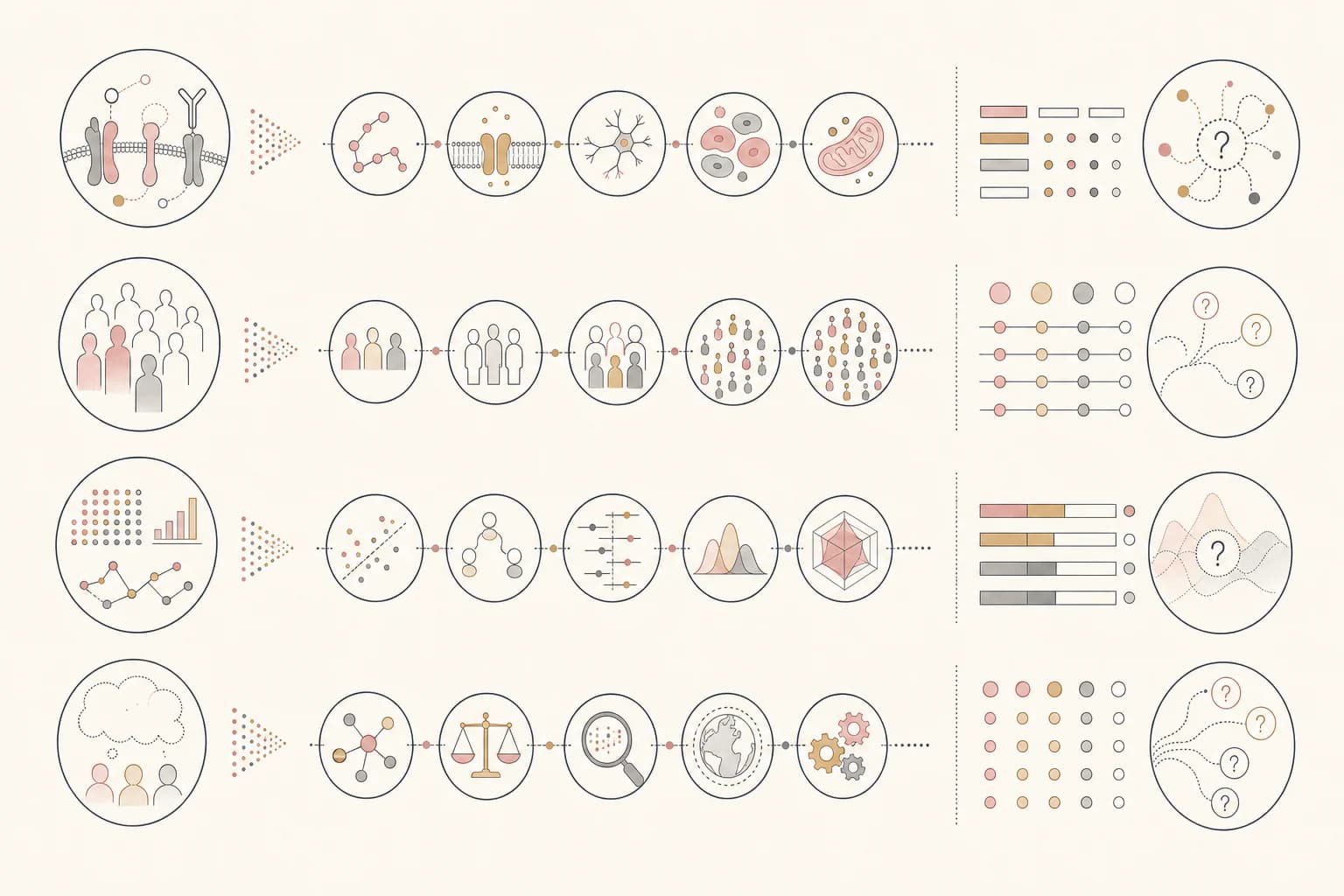
Body composition and metabolic fingerprints
A phase 2 substudy used DXA scans to examine body composition in adults with type 2 diabetes.7 Several retatrutide groups had greater total fat-mass reductions than placebo at 36 weeks.7 The share of lean-mass loss relative to total weight loss resembled that seen with other obesity treatments.7
The substudy was smaller than the main trial, and only 103 participants completed paired scans.7 That makes its finding informative but narrower than a large dedicated body-composition trial.7
Another exploratory analysis studied fasting blood samples from two randomized phase 2 trials.3 Retatrutide was linked with lasting shifts in groups of metabolites.3 The groups related to fatty-acid oxidation and insulin resistance.3 Mediation modeling suggested that some markers tracked part of the weight response.3 However, post-hoc biomarker patterns cannot prove which pathway caused that response.3
Liver fat offers a measurable organ signal
Metabolic dysfunction-associated steatotic liver disease involves excess liver fat in a metabolic context.8 A randomized phase 2a substudy included 98 participants who began with elevated liver fat.8 At 24 weeks, retatrutide groups showed larger average liver-fat reductions than placebo.8
This result is notable because liver imaging measures an organ-specific change, not only total body weight.8 The liver-fat reductions were related to changes in body weight, abdominal fat, and metabolic measures.8 Still, a lower imaging value does not automatically prove less fibrosis or fewer future liver complications.8
That distinction is central to responsible reading.8 A surrogate measurement can reveal biological movement while leaving clinical outcomes unresolved.8 Longer and specifically designed studies are needed to connect such signals with health events.5
Blood lipids reveal a possible mechanism
Researchers also examined proteins that regulate how triglycerides are processed.9 In post-hoc human analyses, decreases in ANGPTL3/8 moved alongside reductions in triglycerides and LDL cholesterol.9 Parallel movement suggests a relationship, but it does not prove that one change caused the other.9
The investigators then studied primary human liver cells in a laboratory.9 Retatrutide and glucagon reduced ANGPTL3/8 secretion, while blocking the glucagon receptor prevented that effect.9 This cell experiment supports a possible glucagon-receptor mechanism.9 It cannot show that the same chain fully explains changes inside a person.9
Together, the human and cell findings frame a testable idea, not a settled biological answer.9
Semaglutide is the established GLP-1 reference point in this research story, and the card below is a neutral catalog reference.
Kidneys and brain: important questions, limited answers
A phase 2b study has been designed around kidney function and structure in adults with chronic kidney disease.5 Its published paper describes the protocol and baseline profile of 146 randomized participants.5 The planned measures include directly measured filtration and imaging of kidney features.5 It does not report whether retatrutide benefits kidneys.5
Earlier biological signals come from animals, with major limits.10 In an insulin-deficient diabetes model, male rats showed partial improvement in selected behavior and inflammation measures.10 Not every memory measure returned to normal.10 Direct retatrutide exposure in the brain was not established.10
A separate rat preprint examined early kidney injury.11 It reported altered hypoxia-related signaling but no statistically significant structural kidney protection.11 Because it is unreviewed and uses an acute animal model, it cannot establish kidney effects in people.11
Fat tissue and a much wider pipeline
A mouse study combined tissue examination, gene activity, and metabolite profiling.12 Retatrutide was associated with changes in lipid processing, mitochondrial activity, inflammatory pathways, and fibrotic remodeling.12 These coordinated findings can shape possible biological explanations.12 However, they cannot demonstrate the same tissue response in people.12
Retatrutide is also only one branch of this research wave.4 Reviews describe candidates combining GLP-1 signaling with GIP, glucagon, amylin, or other gut-hormone pathways.4 Some pair separate agents, while others build several receptor activities into one molecule.4 Oral small-molecule GLP-1 receptor agonists form another direction.4
These approaches are not interchangeable.4 Each has distinct mechanisms, populations, endpoints, adverse-event findings, and development stages.4 For Filipino readers, the useful habit is to identify the evidence behind each claim.4 Human outcomes differ from biomarkers, cells, animals, preprints, and protocols.5
Bottom line
Beyond semaglutide, metabolic drug research is becoming broader and more mechanistically ambitious.4 Retatrutide’s three-receptor design has produced meaningful human trial results in type 2 diabetes.2 Smaller human studies add signals involving appetite, fat mass, liver fat, and blood metabolites.6 Those signals remain bounded by exploratory methods, narrower samples, or surrogate outcomes.7
Kidney, brain, and fat-tissue research is earlier still.5 Protocols tell us what researchers plan to test, while animal and laboratory studies suggest questions rather than human answers.10 The exciting part is the range of biology now under study.4 The responsible conclusion is equally important: evidence strength depends on study design, population, and outcome.2
Frequently asked questions
What does “beyond semaglutide” mean?
It describes research expanding past GLP-1-only signaling.4 New candidates may engage GIP, glucagon, amylin, or other hormone pathways alongside GLP-1.4 The phrase does not mean semaglutide has become scientifically irrelevant.4 It marks a wider set of experimental strategies with separate evidence bases.4
What makes retatrutide different?
Retatrutide is one molecule designed to activate GIP, GLP-1, and glucagon receptors.1 Researchers hope coordinated signaling can affect several metabolic processes.4 That mechanism makes retatrutide distinctive, but it does not guarantee outcomes.1 Human trials remain necessary to measure benefits and adverse events.2
Has retatrutide been studied in people?
Yes. A phase 3 randomized trial studied 537 adults with type 2 diabetes for 40 weeks.2 It found greater HbA1c and body-weight improvements versus placebo.2 The most frequent adverse events were gastrointestinal.2 Those findings apply to the studied population and setting, not automatically to everyone.2
Do appetite findings explain all weight change?
No single explanation was established.6 Exploratory questionnaire analyses found less reported hunger and disinhibition in higher retatrutide groups versus placebo.6 Those changes correlated with weight reductions.6 Self-reports and correlations can support a possible pathway, but they cannot prove that appetite changes caused the full result.6
What did researchers find about liver fat?
A randomized phase 2a substudy found larger liver-fat reductions with retatrutide than placebo at 24 weeks.8 It included 98 participants with elevated liver fat at baseline.8 This imaging outcome is useful, but it does not by itself prove fibrosis improvement or fewer long-term liver complications.8
Are the kidney and brain findings human evidence?
The brain findings described here came from male rats with experimentally induced diabetes.10 A kidney preprint also used diabetic rats and found no significant structural protection.11 A human kidney paper reports a trial design and baseline data, not benefit results.5 These evidence types cannot be merged into a human conclusion.5
Sources
Footnotes
-
Novel GLP-1-based Medications for Type 2 Diabetes and Obesity.. Narrative review of novel GLP-1-based medicines for type 2 diabetes and obesity. A mechanism description does not establish clinical benefit or safety. ↩ ↩2 ↩3 ↩4 ↩5 ↩6 ↩7 ↩8
-
Efficacy and safety of retatrutide, a GIP, GLP-1, and glucagon receptor agonist, in people with type 2 diabetes and inadequate glycaemic control with diet and exercise (TRANSCEND-T2D-1): a double-blind, randomised, phase 3 trial.. Double-blind, placebo-controlled phase 3 trial of 537 adults whose type 2 diabetes was inadequately controlled by diet and exercise. The trial population and controlled setting limit generalization beyond the studied adults. ↩ ↩2 ↩3 ↩4 ↩5 ↩6 ↩7 ↩8 ↩9 ↩10 ↩11 ↩12 ↩13 ↩14 ↩15 ↩16 ↩17 ↩18 ↩19 ↩20
-
Retatrutide And Lipid And Metabolite Profiles In Participants With Obesity With Or Without Type 2 Diabetes.. Exploratory metabolomic and lipidomic analyses of fasting samples from two randomized phase 2 trials. Biomarker associations and mediation analyses cannot prove the biological pathway caused weight change. ↩ ↩2 ↩3 ↩4 ↩5 ↩6
-
Novel GLP-1-based Medications for Type 2 Diabetes and Obesity.. Narrative review of mechanisms and clinical development across novel GLP-1-based medicines. Pipeline inclusion does not show that every candidate will succeed or have the same evidence base. ↩ ↩2 ↩3 ↩4 ↩5 ↩6 ↩7 ↩8 ↩9 ↩10 ↩11 ↩12 ↩13 ↩14 ↩15 ↩16 ↩17 ↩18 ↩19
-
Rationale, design and baseline characteristics of the TRANSCEND-CKD trial of retatrutide in patients with chronic kidney disease.. Published trial rationale, design, and baseline characteristics for 146 randomized adults. The paper reports design and baseline data, not kidney benefit results. ↩ ↩2 ↩3 ↩4 ↩5 ↩6 ↩7 ↩8 ↩9 ↩10
-
Appetite, eating attitudes, and eating behaviours during treatment with retatrutide in adults with type 2 diabetes: Results of a phase 2 study.. Questionnaire-based exploratory analyses in 275 adults with type 2 diabetes over 36 weeks. These were self-reported exploratory outcomes, and comparisons with dulaglutide were less consistent. ↩ ↩2 ↩3 ↩4 ↩5 ↩6 ↩7 ↩8 ↩9 ↩10 ↩11 ↩12 ↩13
-
Effects of retatrutide on body composition in people with type 2 diabetes: a substudy of a phase 2, double-blind, parallel-group, placebo-controlled, randomised trial.. DXA substudy of a randomized trial in adults with type 2 diabetes; 103 participants completed baseline and week-36 scans. This was a smaller substudy with incomplete paired scans, not a stand-alone trial powered for every body-composition question. ↩ ↩2 ↩3 ↩4 ↩5 ↩6 ↩7 ↩8
-
Triple hormone receptor agonist retatrutide for metabolic dysfunction-associated steatotic liver disease: a randomized phase 2a trial.. Double-blind, placebo-controlled human substudy using liver-fat measurements. Liver-fat change is not the same as proving improved fibrosis or long-term clinical outcomes. ↩ ↩2 ↩3 ↩4 ↩5 ↩6 ↩7 ↩8 ↩9 ↩10 ↩11
-
Decreases in circulating ANGPTL3/8 concentrations following retatrutide treatment parallel reductions in serum lipids.. Post-hoc analyses from two phase 2 trials plus experiments in primary human liver cells. Parallel biomarker changes and cell experiments suggest a mechanism but do not prove it operates identically in people. ↩ ↩2 ↩3 ↩4 ↩5 ↩6 ↩7 ↩8
-
Effects of retatrutide on learning and memory in streptozotocin-induced male diabetic rats.. Streptozotocin-induced, insulin-deficient male rat experiment with behavioral, molecular, and tissue assessments. Direct brain exposure was not established, and this animal model does not establish effects in people. ↩ ↩2 ↩3 ↩4 ↩5 ↩6
-
Retatrutide Treatment in Streptozotocin-Induced Diabetic Rats: Renal Inflammatory Cytokines, HIF‑1α Signalling, and Histopathological Injury Profile. Short-term streptozotocin-induced male rat study reported as a preprint. The work is not peer reviewed, used an acute animal model, and cannot establish human kidney effects. ↩ ↩2 ↩3 ↩4
-
Multi-omic profiling reveals Retatrutide alleviates adipose tissue fibrosis via metabolic reprogramming and tissue repair.. High-fat-diet mouse experiment using physiological, tissue, transcriptomic, and metabolomic analyses. Animal and molecular findings are hypothesis-generating and do not establish comparable human tissue effects. ↩ ↩2 ↩3 ↩4