
TL;DR
- Basketball knee trouble is not one diagnosis; pooled ACL injury patterns vary by sex, playing level, and game or training exposure.1
- Rehab evidence follows the injured structure: ACL recovery uses planned exercise and return milestones, while patellar-tendon research tests planned loading.2
- BPC-157 attention rests mostly on preclinical work, including a positive rat Achilles study that cannot establish recovery from a human basketball knee injury.3
- Current sport context matters because FDA’s 2026 briefings note that WADA lists BPC-157 and TB-500 in two prohibited-substance categories.4
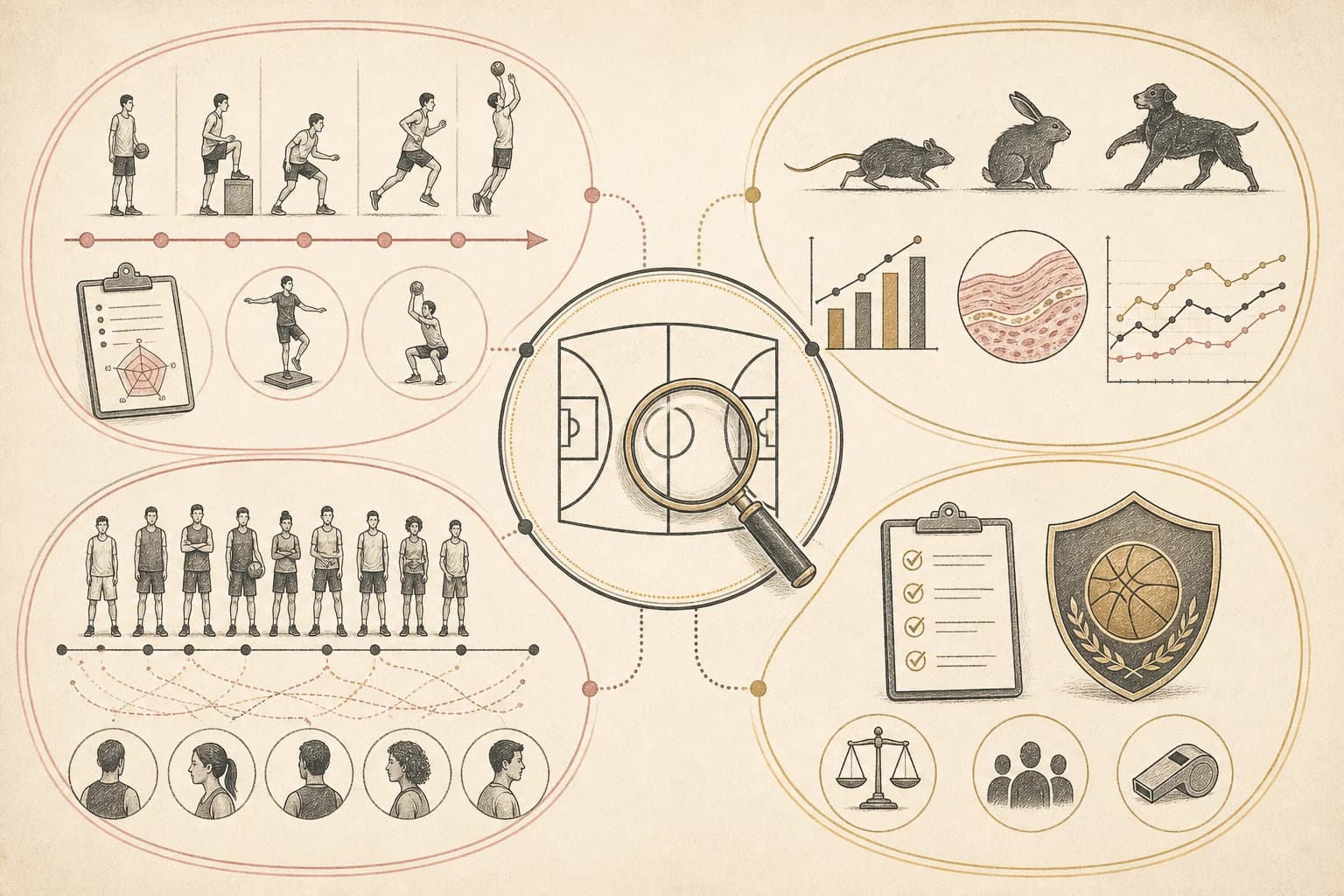
On a court in the Philippines, the same painful knee can mean very different things to a weekend player, a varsity guard, or a returning athlete. A hard twist, repeated jumping, and soreness below the kneecap do not create one shared problem.1 A peptide story may promise a shortcut.5 The useful question is which tissue, model, outcome, and timeline were actually studied.5
First, separate the injury from the recovery pitch
An ACL tear and patellar tendinopathy belong to different evidence lanes.2 The ACL is a stabilizing ligament inside the knee, while patellar-tendon research measures pain, function, sport ability, and response to planned loading.6 A rehab plan therefore begins with the affected structure and the demands that must be rebuilt.2
Peptide claims often collapse these details into the single word “healing.”5 That shortcut hides whether the evidence came from a person with knee pain, a rat with a detached Achilles tendon, or cells in a laboratory.3 Those models can each answer a useful question, but they cannot answer the same question.5 A claim about a tissue signal is not automatically a claim about cutting, landing, or returning to basketball.5
BPC-157 is named here only as the neutral catalog reference below.5
Basketball creates a specific knee-risk setting
Basketball repeatedly asks players to accelerate, stop, jump, land, and change direction.1 A meta-analysis covering 30 basketball studies found that ACL injury incidence per 1,000 athlete-exposures was higher in female than male players.1 The pooled rate was also higher in games than in training.1 These are group patterns, not a forecast for any Filipino player.1
A broader review across 45 team-ball-sport studies found that non-contact events accounted for 55% of ACL injuries overall.7 Competition incidence was higher than training incidence in that pooled record.7 Yet the analysis also reported substantial differences among studies, and some ACL injuries followed contact.7
The practical reading is careful rather than fearful.7 Court movements help explain why strength, control, and sport-specific tasks appear in rehab.2 The exact path still depends on the injury and the person.2
ACL rehabilitation is a staged rebuild
The Aspetar guideline calls exercise the mainstay after ACL reconstruction.2 It describes some physical modalities as possible early add-ons when pain, swelling, or limited motion make exercise harder.2 The central work remains progressive exercise rather than a single recovery event.2
Return to running and return to training are key milestones in the guideline.2 A separate scoping review found that clearance decisions have used six broad domains: time, strength, hop tests, clinical examination, patient reports, and performance tests.8 That list explains why a calendar date alone cannot represent the whole knee.8
It also makes the rehab story visible.8 Progress can be checked through motion, strength, symptoms, confidence, and basketball tasks.8 The review describes criteria in use; it does not promise that passing one checklist removes every risk.8
Jumper’s knee follows a loading question
Patellar tendinopathy is often discussed as “jumper’s knee,” but the human trial used more exact outcomes.6 The randomized study included 76 people with mostly long-lasting symptoms.6 Researchers compared planned tendon loading with eccentric exercise alone.6 After 24 weeks, the planned-loading group improved more on the VISA-P score for pain, function, and sport ability.6
That result belongs to the study population, which was mostly male and had a median symptom duration of two years.6 It does not cover every painful knee or prove that one routine suits every player.6
A separate movement study ranked 35 exercises into three patellar-tendon loading tiers using peak load, loading rate, and total load.9 The participants were healthy adults, so the work maps exercise demands rather than patient recovery.9 Together, the studies show why “load” is planned and progressed, not simply switched on or off.9
What the BPC-157 animal study actually found
One frequently cited BPC-157 paper used rats whose Achilles tendons had been sharply detached from the heel bone.3 Across 21 days, BPC-157 groups had better function and strength measures than saline controls.3 Tissue and collagen measures also favored the BPC-157 groups.3 That is a positive result in the model the researchers built.3
The model is also the boundary.3 The tissue was an Achilles tendon, the injury was created surgically, the subjects were rats, and the follow-up was short.3 None of those details matches a Filipino basketball player with an ACL tear, patellar tendinopathy, or an uncertain source of knee pain.3
The right response is not to erase the finding.3 It is to keep the noun attached: rat tendon-to-bone evidence.3 Moving from that result to human cutting, landing, pain, function, or return to play requires human measurements designed for those outcomes.5
The small human knee report is narrower
A 2021 report reviewed one year of charts from a Florida clinic and contacted 16 people with varied causes of knee pain.10 Twelve had received BPC-157 alone inside the knee joint, and 11 of those 12 reported improvement during phone follow-up.10 The positive responses are part of the record and should be stated accurately.10
The same paper says it used no validated tool to measure function, quality of life, stiffness, or daily activity.10 It had no comparison group and did not report a basketball return test or structural-repair outcome.10 The report describes what a small, mixed group recalled.10 It cannot carry the same meaning as a randomized rehab trial.10
A 2025 review placed this report among only three human pilot studies across several unrelated settings.5 That review called for larger human trials to assess safety and clinical utility.5
Regulation and anti-doping answer different questions
FDA’s July 2026 staff review found too little clinical safety information to describe BPC-157’s safety profile.11 It also noted possible immune-response concerns tied to peptide clumps and impurities.11 The review asked whether two BPC-157 forms belonged on an American compounding list.11 It did not measure an outcome for a specific catalog item.11
FDA’s separate TB-500 review found no information on products given to humans and no in-vivo wound-repair pharmacology study for TB-500.12 It also raised characterization and immune-response concerns.12 Those statements concern the exact TB-500 substances reviewed, not every study of full-length thymosin-beta-4.12
For athletes under WADA rules, the question is more direct.4 FDA’s 2026 briefings say WADA places BPC-157 in its non-approved substances category and TB-500 in its growth-factor category.4
TB-500 is named here only as the neutral catalog reference below.
Bottom line
Basketball knee recovery becomes clearer when the injury, evidence model, and measured outcome stay together.2 ACL rehab uses planned exercise and several return-to-sport checks.8 Patellar-tendon research tests planned loading over time.6 BPC-157 has positive animal findings and a small chart-based human knee report.10 Neither one recreates a controlled basketball rehab path.10 FDA’s 2026 reviews add safety and product-identity concerns for BPC-157 and TB-500.4 WADA rules create a separate issue for covered athletes.4 For Filipino readers, the fair comparison is not rehab versus “healing” as slogans.5 It is human function data versus animal, lab, chart-based, regulatory, and sport-rule records.5 Each record must stay within its proper boundary.5
This article is educational research context, not medical advice. Catalog links are neutral references and do not imply a treatment or human-use recommendation.
Frequently asked questions
Is every basketball knee injury an ACL tear?
No. The studies here separate ACL injury patterns from patellar-tendon pain and loading.1 Even within ACL research, pooled rates differ by sex, playing level, and game or training exposure.1 A general phrase such as “basketball knee” cannot identify the injured structure or define one rehab path.2
What does criterion-based rehabilitation mean?
It means progress is checked through more than time alone.8 The ACL return-to-sport literature groups criteria into strength, hop testing, clinical examination, patient reports, performance tasks, and time.8 These domains organize a decision; the review does not say one score or checklist guarantees a risk-free return.8
What did progressive loading change in patellar tendinopathy?
In a randomized trial, 76 patients followed progressive tendon loading or eccentric exercise alone.6 At 24 weeks, the progressive group improved more on the VISA-P score covering pain, function, and sport ability.6 The participants mostly had long-lasting symptoms, so the finding does not represent every painful knee.6
Did the rat BPC-157 study involve a knee?
No. Researchers sharply detached the Achilles tendon from heel bone in rats and followed outcomes through 21 days.3 They reported better function, tissue structure, collagen, and strength measures in BPC-157 groups than controls.3 Those findings do not recreate an ACL or patellar-tendon rehab study in people.3
What did the human BPC-157 knee report measure?
It used a retrospective chart review and phone follow-up among people with different causes of knee pain.10 Eleven of 12 contacted people who had received BPC-157 alone reported improvement.10 The report used no validated measure of function, stiffness, quality of life, or daily activity and had no comparison group.10
Why should competitive athletes check WADA rules?
FDA’s 2026 briefings say WADA lists BPC-157 among non-approved substances and TB-500 among growth factors and modulators.4 These sport categories are separate from injury rehab evidence.4 Covered athletes should read the current WADA list and their competition rules.4
Sources
Footnotes
-
The incidence rate of ACL injuries and ankle sprains in basketball players: A systematic review and meta-analysis. Systematic review and meta-analysis of basketball studies reporting ACL injuries and athlete-exposures. The pooled rates combine different populations and settings and do not predict an individual player's injury. ↩ ↩2 ↩3 ↩4 ↩5 ↩6 ↩7 ↩8
-
Aspetar clinical practice guideline on rehabilitation after anterior cruciate ligament reconstruction. Clinical practice guideline based on randomized trials, systematic reviews, and expert consensus for rehabilitation after ACL reconstruction. The guideline reports limited certainty for many components and does not define one universal program. ↩ ↩2 ↩3 ↩4 ↩5 ↩6 ↩7 ↩8 ↩9 ↩10 ↩11
-
Achilles detachment in rat and stable gastric pentadecapeptide BPC 157: Promoted tendon-to-bone healing and opposed corticosteroid aggravation. Controlled rat Achilles tendon-to-bone experiment after sharp surgical detachment. This was an Achilles injury in rats, not a basketball knee injury or a human rehabilitation trial. ↩ ↩2 ↩3 ↩4 ↩5 ↩6 ↩7 ↩8 ↩9 ↩10 ↩11 ↩12 ↩13 ↩14
-
FDA Briefing Document for BPC-157-Related Bulk Drug Substances; FDA Briefing Document for TB-500-Related Bulk Drug Substances. Current U.S. FDA briefing documents that identify each substance's World Anti-Doping Agency category. Anti-doping status is a sport-rule issue and does not establish a medical outcome or a decision by another national regulator. ↩ ↩2 ↩3 ↩4 ↩5 ↩6 ↩7 ↩8
-
Regeneration or Risk? A Narrative Review of BPC-157 for Musculoskeletal Healing. Narrative review of preclinical and clinical BPC-157 literature. The review maps the published field and does not supply a positive basketball-recovery outcome. ↩ ↩2 ↩3 ↩4 ↩5 ↩6 ↩7 ↩8 ↩9 ↩10 ↩11 ↩12
-
Effectiveness of progressive tendon-loading exercise therapy in patients with patellar tendinopathy: a randomised clinical trial. Investigator-blinded randomized human trial with clinically diagnosed and ultrasound-confirmed patellar tendinopathy. The population was mostly male and had a median symptom duration of two years, so the result does not cover every source of knee pain. ↩ ↩2 ↩3 ↩4 ↩5 ↩6 ↩7 ↩8 ↩9 ↩10 ↩11
-
Non-contact Anterior Cruciate Ligament Injury Epidemiology in Team-Ball Sports: A Systematic Review with Meta-analysis by Sex, Age, Sport, Participation Level, and Exposure Type. Systematic review and meta-analysis across 13 team ball sports, not basketball alone. Statistical heterogeneity was high, and not every ACL injury is non-contact or preventable. ↩ ↩2 ↩3 ↩4
-
Which criteria are used to clear patients to return to sport after primary ACL reconstruction? A scoping review. Scoping review of criteria used after primary ACL reconstruction. The review describes criteria in use; it does not establish that one checklist guarantees a safe return. ↩ ↩2 ↩3 ↩4 ↩5 ↩6 ↩7 ↩8 ↩9
-
Patellar Tendon Load Progression during Rehabilitation Exercises: Implications for the Treatment of Patellar Tendon Injuries. Biomechanical study of healthy adults performing squats, lunges, jumps, hops, landings, running, and sport-specific tasks. The loading tiers guide progression logic but were not a clinical outcome trial in injured basketball players. ↩ ↩2 ↩3
-
Intra-Articular Injection of BPC 157 for Multiple Types of Knee Pain. Small uncontrolled retrospective report using phone follow-up in people with varied causes of knee pain. The report used no validated measure of function, quality of life, stiffness, or daily activity and did not establish structural repair or basketball return. ↩ ↩2 ↩3 ↩4 ↩5 ↩6 ↩7 ↩8 ↩9 ↩10 ↩11 ↩12
-
FDA Briefing Document for BPC-157-Related Bulk Drug Substances. Current U.S. FDA review for consideration of BPC-157 free base and acetate on the 503A Bulks List. This is a U.S. compounding review, not a Philippine regulatory decision and not an assessment of a specific catalog item. ↩ ↩2 ↩3 ↩4
-
FDA Briefing Document for TB-500-Related Bulk Drug Substances. Current U.S. FDA review for consideration of TB-500 free base and acetate on the 503A Bulks List. The statement reports the scope of FDA's documented search and review; it is not a Philippine regulatory decision. ↩ ↩2 ↩3