TL;DR
- AOD-9604 is a synthetic 16-amino-acid peptide based on human growth hormone residues 177-191, with an extra tyrosine at its N-terminus.1
- A 1993 rat-tissue experiment reported that hGH 177-191 reduced new lipid formation in its laboratory setup.2
- A 14-day obese-mouse experiment reported changes in body weight, body fat, and receptor-related signals, but those findings do not establish human outcomes.3
- In the larger 24-week OPTIONS study, 502 adults with obesity were randomized, and the primary weight-change result did not differ significantly from placebo.4
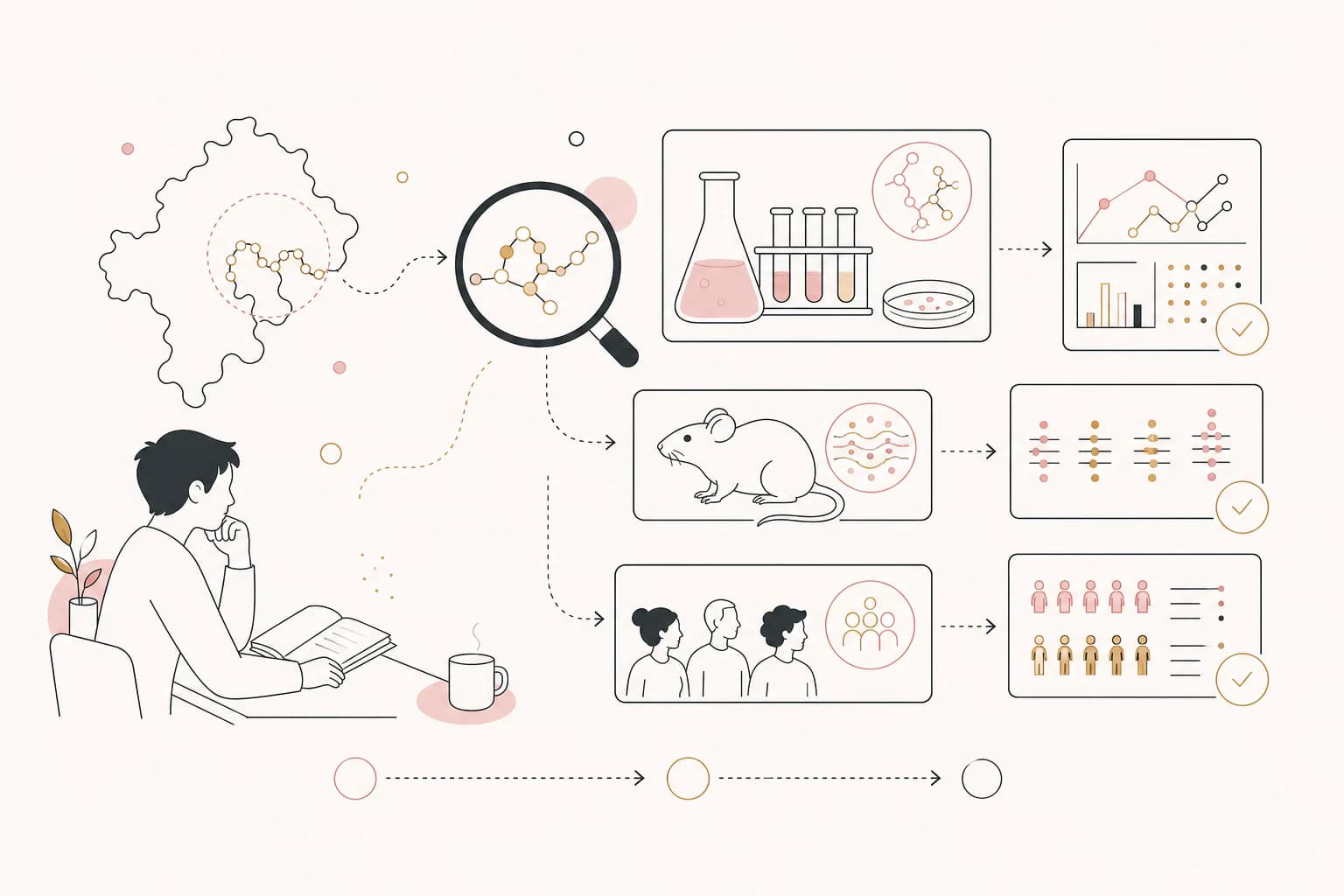
For Filipino readers, the useful approach is to move through this research one experiment at a time. The idea began with a small part of a much larger hormone.1 It moved through rat and mouse experiments before meeting a harder test in people.24 The key question is not whether one dramatic finding sounds persuasive. It is what each experiment actually measured.
What AOD-9604 is
AOD-9604 consists of the C-terminal part of human growth hormone spanning amino acids 177 through 191, plus an extra tyrosine at the N-terminus.1 This explains why readers may also see the nearby label “hGH fragment 176-191”: counting the added tyrosine produces a 16-amino-acid sequence.1
That identity matters because the original research question was unusually narrow.1 Instead of studying the entire growth-hormone molecule, investigators focused on a short end segment and asked whether selected metabolic signals remained.2 The name records the design idea; it does not report a human result.1 Later experiments had to test the fragment in tissue, animals, and people separately.254
AOD-9604 is named here only to introduce the following neutral catalog reference.
The idea began with rat tissue
The early evidence did not start with a scale. In 1993, researchers studied synthetic hGH 177-191 using tissue from rats.2 They reported that the fragment reduced new lipid formation to the same degree as intact human growth hormone in that experimental setup.2 This “antilipogenic” result concerned making or storing lipid, not an observed change in a person’s body weight.2
The same paper also delivered an important counterpoint. Its selected measure of lipid breakdown was glycerol released from epididymal fat pads.6 On that outcome, the investigators found no significant lipolytic effect.6 The experiment therefore offered a specific positive signal and a specific negative one.26 Reading both prevents “less lipid formation” from being casually rewritten as a broad claim about fat loss.26
Whole-animal studies added a new layer
Researchers next examined AOD9604 in obese Zucker rats.5 Over 19 days, exposed rats gained 15.8 grams on average, compared with 35.6 grams in control animals.5 Their weight gain was reduced by more than half.5 This was slower gain in a rat model, not demonstrated weight loss in adults.5
The investigators also reported higher lipolytic activity in the animals’ adipose tissue.7 A glucose-clamp comparison found that AOD9604 did not worsen insulin sensitivity in those rats, while intact human growth hormone did.8 That contrast helped sharpen the development idea: perhaps a short fragment could preserve selected metabolic signals without copying every action of the full hormone.78
Still, neither the tissue finding nor the rat comparison established metabolic safety in humans.78 Species, model, endpoint, and follow-up remained tied to the experiment.5

Mouse experiments complicated the mechanism
A separate 14-day study compared obese mice and genetically modified mice lacking beta-3 adrenergic receptors.39 In the obese mice, AOD9604 was linked with lower body weight and body fat, plus increased beta-3 receptor RNA expression.3 Those findings suggested that this signaling pathway might be involved.3
The knockout experiment made the picture less simple. With the receptor removed, longer exposure did not produce the body-weight or lipolysis changes seen in ordinary mice.9 Yet a short experiment still found increased energy expenditure and fat oxidation in the knockout mice.9 The authors therefore did not describe AOD9604 as acting directly through one receptor.9
This experiment narrowed the hypothesis while showing that one pathway did not explain every observed response.9
Early human studies were small
The first human summaries did not reproduce the animal story in a simple way.1011 One double-blind study included 23 adults with obesity and followed average weight change over three weeks.10 The reported 0.58-kilogram average change was not statistically different from placebo.10 FDA later noted that the summary lacked enough methodology, study parameters, and numerical detail for a strong interpretation.10
Another study involved 16 men with obesity over four weeks.11 It reported no statistically significant weight difference from placebo.11 These studies were not meaningless, but their role was limited: they tested early signals in small groups over short periods.1011
The contrast with the rodent work is central. A biological signal in a model may justify a human comparison, but it cannot supply the outcome of that comparison.510
A 12-week signal needed more context
A later randomized study enrolled 300 adults with obesity and ran for 12 weeks.12 Its conference abstract reported the largest weight-change signal in one AOD-9604 group, while the pattern across groups was not linear.12 FDA described the differences as small and the clinical meaning as unclear.12
More importantly, the record was thin. FDA found too little detail in the abstract about methods, measurements, and results.12 It also did not locate a full medical-journal publication of the study.12 That limit changes how the positive signal should be read.12 A short abstract can flag an observation, but it gives readers less information for checking participant flow, endpoint handling, and the complete comparison.12
The fairest summary is precise: one group showed a preliminary signal, while the documentation did not support a broad conclusion.12
HGH fragment 176-191 is named here only to introduce the following neutral catalog reference.
The larger trial changed the direction
The 24-week OPTIONS study was the decisive human comparison in this development program.4 It enrolled 536 adults with obesity and randomized 502 of them to AOD-9604 or placebo groups alongside a supervised diet and exercise program.4 The study asked whether any AOD-9604 group produced a statistically significant difference from placebo on its primary weight-change endpoint.4
It did not.4 The primary result showed no statistically significant difference between AOD-9604 and placebo.4
Detailed methods and results were not published in the medical literature, so readers should not invent subgroup explanations or hidden successes.4 The supported conclusion is narrower and clearer: the larger randomized comparison did not confirm the required primary effect.4
Safety summaries still have boundaries
Safety language requires the same discipline as outcome language. FDA’s 2024 review described the human safety information as limited because the summaries lacked detailed adverse-event breakdowns, laboratory values, and longer follow-up.13 That means a reassuring sentence from an early report cannot settle the broader safety picture.13
FDA’s current compounding safety page adds a different, product-quality concern. It says compounded drugs containing AOD-9604 may carry immunogenicity risks for some routes and may have complexities involving peptide impurities and ingredient characterization.14 The agency says it lacks enough information to determine whether human exposure would cause harm.14 It also notes that causality remains unclear for serious adverse events it identified.14
This is not a positive or negative efficacy result. It is a regulatory safety boundary around limited information and compounded preparations.14
Bottom line
AOD-9604 came from a focused idea: examine a short C-terminal segment of human growth hormone rather than the whole molecule.12 Rat tissue, obese-rat studies, and mouse experiments produced several metabolic signals, plus findings that complicated a simple receptor explanation.2539 Those models gave researchers reasons to continue, not human conclusions.
The human chapter was less encouraging.10114 Small early studies did not show statistically significant differences from placebo.1011 One 12-week abstract offered an incompletely documented signal.12 The larger OPTIONS study missed its primary weight-change endpoint.4 FDA also describes the clinical safety record as limited.13 The clearest reading respects that full arc, including the negative result.4
This article is educational research context, not medical advice. Catalog links are neutral references and do not imply a treatment or human-use recommendation.
Frequently asked questions
Why is AOD-9604 linked to growth hormone?
Its sequence comes from amino acids 177-191 at the C-terminal end of human growth hormone, with an added tyrosine at the N-terminus.1 Researchers isolated that short segment to test selected signals separately from the complete hormone.2 The structural link does not mean the fragment copies every action of growth hormone.8
What did the first fragment study find?
The 1993 rat-tissue study reported reduced lipid formation with hGH 177-191.2 It did not find a significant increase in glycerol release, its measure of lipid breakdown.6 The two findings answer different laboratory questions, so the positive result should not erase the negative one.26
Did animal studies report weight changes?
Yes, within specific rodent models.53 Obese Zucker rats showed less weight gain than controls, while an obese-mouse study reported lower body weight and body fat.53 These outcomes belong to rats and mice under defined experimental conditions and do not establish the same outcome in people.53
What happened in the largest human study?
The OPTIONS study enrolled 536 adults with obesity and randomized 502 over 24 weeks.4 Its primary weight-change endpoint did not differ significantly between AOD-9604 and placebo.4 A detailed medical-journal report was not published, so the supported interpretation should remain with that reported primary result.4
Was there any positive human signal?
A 12-week study in 300 adults reported its largest signal in one group.12 The response across groups was not linear, and FDA found the conference abstract too sparse for clear interpretation.12 FDA also did not locate a complete publication of the methods and findings.12
How should Filipino readers interpret this research?
Separate each layer. Rat tissue can answer a laboratory question, animal models can explore biology, and randomized human comparisons test outcomes in people.254 For AOD-9604, the larger human study did not confirm its primary effect, while FDA describes the clinical safety information as limited.413
Sources
Footnotes
-
Detection and in vitro metabolism of AOD9604.. Identity statement from a PubMed-indexed analytical study. This chemical identity does not establish a human outcome. ↩ ↩2 ↩3 ↩4 ↩5 ↩6 ↩7 ↩8
-
Antilipogenic action of synthetic C-terminal sequence 177-191 of human growth hormone.. Laboratory measurements using tissue from peptide-exposed rats. This was not a clinical outcome in people. ↩ ↩2 ↩3 ↩4 ↩5 ↩6 ↩7 ↩8 ↩9 ↩10 ↩11 ↩12 ↩13 ↩14 ↩15
-
The effects of human GH and its lipolytic fragment (AOD9604) on lipid metabolism following chronic treatment in obese mice and beta(3)-AR knock-out mice.. Animal study in obese mice. The result concerns a short mouse experiment, not a human trial. ↩ ↩2 ↩3 ↩4 ↩5 ↩6 ↩7 ↩8
-
FDA Briefing Document: Evaluation of AOD-9604-Related Bulk Drug Substances (AOD-9604 (free base) and AOD-9604 acetate). Randomized, double-blind, placebo-controlled phase 2B study summarized in the FDA briefing document. Detailed methods and results were not published in the medical literature. ↩ ↩2 ↩3 ↩4 ↩5 ↩6 ↩7 ↩8 ↩9 ↩10 ↩11 ↩12 ↩13 ↩14 ↩15 ↩16 ↩17 ↩18
-
Metabolic studies of a synthetic lipolytic domain (AOD9604) of human growth hormone.. Animal study in obese Zucker rats. Reduced weight gain in rats is not evidence of weight loss in people. ↩ ↩2 ↩3 ↩4 ↩5 ↩6 ↩7 ↩8 ↩9 ↩10 ↩11 ↩12
-
Antilipogenic action of synthetic C-terminal sequence 177-191 of human growth hormone.. Laboratory measurement in epididymal fat pads from rats. The result was negative for this specific lipid-breakdown measure. ↩ ↩2 ↩3 ↩4 ↩5 ↩6
-
Metabolic studies of a synthetic lipolytic domain (AOD9604) of human growth hormone.. Animal tissue outcome in obese Zucker rats. The finding was measured in rat tissue. ↩ ↩2 ↩3
-
Metabolic studies of a synthetic lipolytic domain (AOD9604) of human growth hormone.. Comparative metabolic testing in obese Zucker rats. An animal comparison cannot establish human metabolic safety. ↩ ↩2 ↩3 ↩4
-
The effects of human GH and its lipolytic fragment (AOD9604) on lipid metabolism following chronic treatment in obese mice and beta(3)-AR knock-out mice.. Mechanistic experiments in genetically modified mice. The mixed findings did not identify a simple direct receptor mechanism. ↩ ↩2 ↩3 ↩4 ↩5 ↩6
-
FDA Briefing Document: Evaluation of AOD-9604-Related Bulk Drug Substances (AOD-9604 (free base) and AOD-9604 acetate). Small early human study summarized in the 2024 FDA briefing document. FDA noted limited methodology, study parameters, and numerical detail. ↩ ↩2 ↩3 ↩4 ↩5 ↩6 ↩7 ↩8
-
FDA Briefing Document: Evaluation of AOD-9604-Related Bulk Drug Substances (AOD-9604 (free base) and AOD-9604 acetate). Small early human study summarized in the 2024 FDA briefing document. FDA noted that the publication supplied only limited study detail. ↩ ↩2 ↩3 ↩4 ↩5 ↩6
-
FDA Briefing Document: Evaluation of AOD-9604-Related Bulk Drug Substances (AOD-9604 (free base) and AOD-9604 acetate). Conference abstract summarized in the 2024 FDA briefing document. The reported signal was non-linear, small, and incompletely documented. ↩ ↩2 ↩3 ↩4 ↩5 ↩6 ↩7 ↩8 ↩9 ↩10 ↩11 ↩12
-
FDA Briefing Document: Evaluation of AOD-9604-Related Bulk Drug Substances (AOD-9604 (free base) and AOD-9604 acetate). FDA evaluation of published summaries and nominated material. This describes limits of the reviewed safety record rather than proving that a particular harm occurred. ↩ ↩2 ↩3 ↩4
-
Certain Bulk Drug Substances for Use in Compounding that May Present Significant Safety Risks. Current FDA compounding safety page. FDA also notes that causality is unclear for serious adverse events it identified. ↩ ↩2 ↩3 ↩4