
TL;DR
- Amylin is released with insulin and helps signal that a meal can end. Its wider physiology also includes slower stomach emptying and lower glucagon secretion.1
- GLP-1 and amylin are not two names for the same pathway. Cagrilintide targets amylin and calcitonin receptors, while semaglutide targets the GLP-1 receptor.2
- Animal research suggests the brain can distinguish these signals. A rat experiment blocked cagrilintide’s effects through one brainstem mechanism without blocking semaglutide’s.3
- Human trials show combination outcomes, not a complete map of appetite. They cannot assign every observed change to one pathway or prove a simple synergy story.4
In the Philippines, health conversations often turn complex hormone science into a contest between familiar names. That shortcut misses the interesting part. Amylin and GLP-1 are separate biological signals, although both can shape eating and metabolism.2 Understanding the distinction makes research headlines easier to read without turning early evidence into personal guidance.
First, picture two different meal messages
Amylin is a hormone released from pancreatic beta cells alongside insulin.1 It contributes to the brain’s message that a meal can finish.1 It also slows stomach emptying and suppresses glucagon, another hormone involved in glucose regulation.5 GLP-1 works through its own receptor, so it is not simply another form of amylin.2
A useful mental picture is two doorbells connected to overlapping rooms. Both may influence eating, yet each starts with a different button and wiring. Cagrilintide activates amylin and calcitonin receptors, while semaglutide activates the GLP-1 receptor.2 That receptor difference is the cleanest starting point. It explains why researchers study each pathway alone and together, without assuming identical biological routes.
Neutral catalog reference — cagrilintide.
What the amylin pathway does
Amylin’s story begins during a meal, when pancreatic beta cells release it with insulin.1 Its actions connect digestion, glucose handling, and central signals involved in ending a meal.1 Reviews describe slower stomach emptying and suppressed glucagon as part of that physiology.5
That does not mean amylin acts through one simple “fullness switch.” The evidence spans organs, receptors, and brain circuits.1 It also comes from mixed settings, including laboratory work, animal models, and human studies of different analogues.6 Long-acting amylin analogues were developed from this broader research history.6
Cagrilintide is one such analogue and activates both amylin and calcitonin receptors.2 This classification describes its biological target. It does not, by itself, tell us how any individual would respond or separate appetite effects from other metabolic changes.
What makes GLP-1 a separate route
Semaglutide is a GLP-1 receptor agonist, unlike cagrilintide’s amylin and calcitonin receptor activity.2 That difference matters because receptor labels identify where a signal begins. They do not say that downstream effects must remain completely separate.
Human combination studies often measure body weight, blood glucose, and adverse events rather than appetite circuits directly.7 Consequently, a change in those outcomes cannot be translated into a precise percentage contribution from each pathway.4 Even a stronger result with two agents does not prove that their appetite effects simply add together.
The simplest accurate comparison is therefore modest. Amylin-based and GLP-1-based compounds start through different receptors.2 Their effects can converge on eating and metabolism, while the full chain between receptor activity and a trial outcome remains more complicated.4
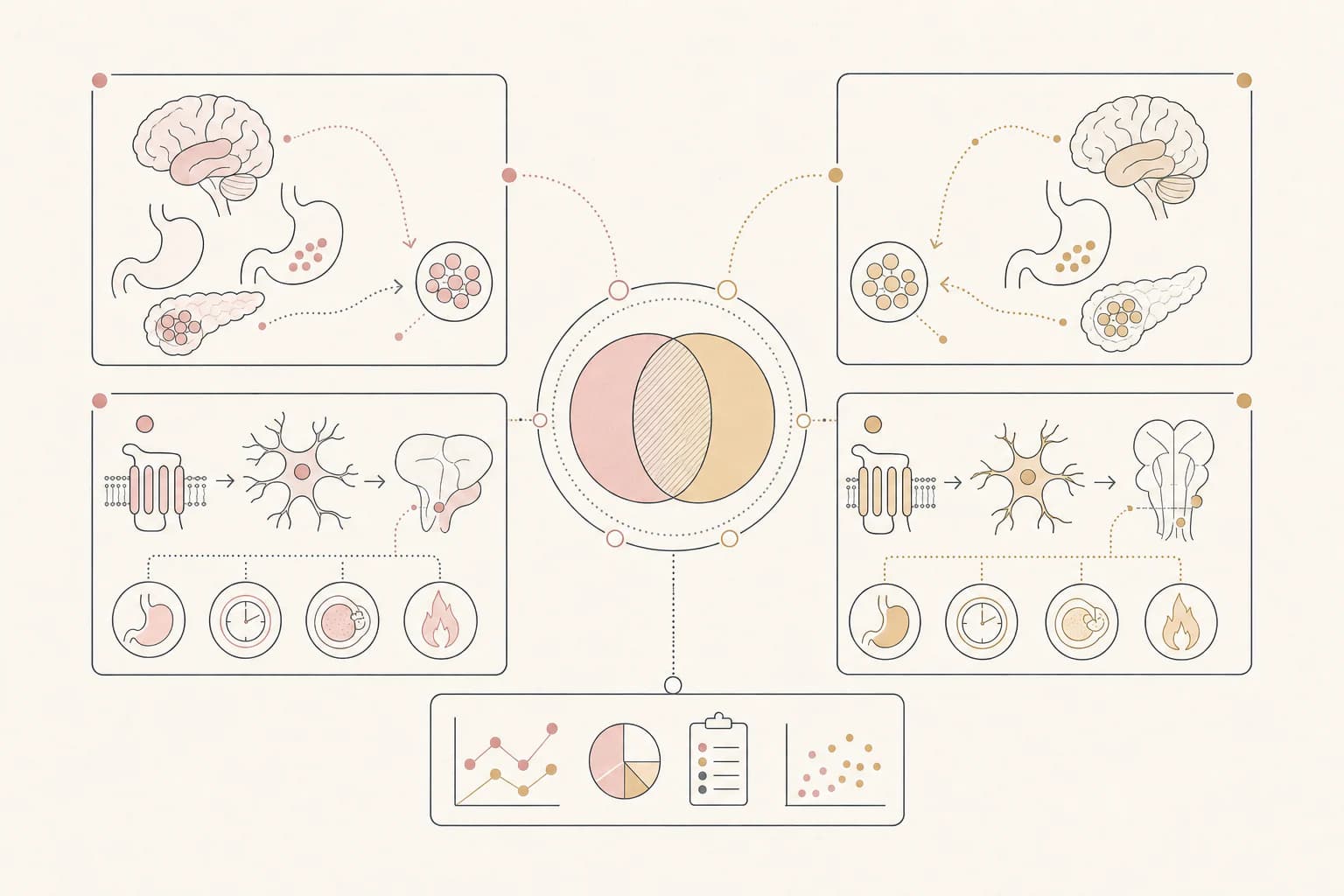
The brainstem evidence comes mainly from animals
A 2026 study mapped more than 530,000 cells across rat, mouse, and macaque brainstems.8 Researchers focused on the dorsal vagal complex, a brainstem region involved in processing body signals.3 They identified cagrilintide-responsive cell populations carrying calcitonin-receptor features.3
The strongest causal test was in rats. Reducing prolactin-releasing hormone in that brainstem region disrupted cagrilintide’s effects but did not disrupt semaglutide’s.3 This finding supports different biological routes within that animal model.
Related cell populations appeared conserved across rodents, macaques, and humans.8 However, shared cell signatures do not prove identical functions in living people.8 The experiment should not be retold as direct evidence of a human appetite circuit. It is a detailed mechanistic clue, with a clear species boundary.
What human combination trials actually measure
One 68-week phase 3a trial enrolled 3,417 adults with overweight or obesity and without diabetes.7 Participants were randomly assigned to the combination, either component, or placebo, alongside lifestyle intervention.7 The combination produced a greater mean body-weight reduction than placebo.7
That result shows what happened under a controlled trial design. It does not isolate how much came from amylin signalling, GLP-1 signalling, their interaction, or other downstream effects.4 Body weight is also broader than appetite, because many biological and behavioural factors shape it.
A meta-analysis later pooled four randomized trials involving 5,023 participants.9 It found reductions with cagrilintide-based approaches compared with placebo.9 Yet its pooled evidence mixed cagrilintide alone with the cagrilintide-semaglutide combination.9 That makes it useful for an overview, but less clean for explaining one mechanism.
An East Asian trial adds useful, limited context
A phase 3a trial in Japan and Taiwan enrolled 331 adults with overweight or obesity.10 Some participants had type 2 diabetes, and eligibility followed defined body-size and health criteria.10 After 68 weeks, mean body-weight reduction was greater with cagrilintide-semaglutide than with semaglutide alone.10
This setting is nearer to the Philippines than many global trial sites.10 Still, it was not a Philippine study, and its participants cannot represent every East Asian population.10 The randomized groups had different results under those trial conditions.10 This does not prove a universal response or explain the exact neural pathway behind the difference.4
Gastrointestinal events were the most common adverse events in both active groups.11 That safety observation belongs beside the headline outcome. It helps keep the evidence balanced without predicting what any individual might experience.
Metabolic outcomes are not appetite readouts
REIMAGINE 2 studied 2,713 adults with type 2 diabetes receiving metformin, sometimes with another glucose-lowering medicine.12 The combination reduced HbA1c more than semaglutide alone after 68 weeks.12 HbA1c reflects longer-term blood glucose, not a direct measurement of hunger or fullness.
This distinction prevents a common reading error. A trial may support better glycaemic control without revealing exactly what happened inside appetite circuits.12 Likewise, a body-weight outcome cannot show when meal-ending signals arose or which brain cells carried them.4
Combination studies remain valuable because they compare outcomes in people under randomized conditions.7 Mechanistic studies remain valuable because they test biological explanations, often in animals.3 Neither type should silently substitute for the other. Together, they offer a layered picture, but important gaps remain between receptors, lived appetite, and long-term outcomes.
Neutral catalog reference — semaglutide.
Reading “two pathways” without oversimplifying
The phrase “two pathways” is a teaching tool, not a claim that each hormone follows one isolated wire. Cagrilintide and semaglutide begin at different receptor targets.2 Rat experiments also support at least one separable brainstem mechanism for cagrilintide.3
Still, human trials observe the combined output of many systems.4 They do not directly trace every signal from receptor to meal size, daily eating, and body-weight change.4 Reviews further combine results from different molecules and stages of development.6 That breadth is informative, but it demands careful wording.
Each question needs the right kind of study. Reviews summarize physiology.1 Animal experiments probe mechanisms.3 Randomized human trials compare measured outcomes between groups.7 Keeping those roles separate makes the comparison simpler and more honest.
Bottom line
Amylin and GLP-1 are distinct hormone pathways, not competing names for the same appetite signal.2 Amylin is released with insulin and takes part in meal-ending, digestive, and glucagon-related functions.1 GLP-1-based semaglutide begins through a different receptor target than amylin-based cagrilintide.2
Animal work suggests cagrilintide can depend on a brainstem mechanism that semaglutide does not share in the same way.3 Human trials show group differences for combinations, but those outcomes do not fully explain appetite biology.4 For Filipino readers, the useful conclusion is not that one pathway “wins.” Different signals may meet, while each claim must stay tied to its study type and population.4
Frequently asked questions
Is amylin the same hormone as GLP-1?
No. Amylin is released with insulin from pancreatic beta cells, while GLP-1 signals through the GLP-1 receptor.1 Cagrilintide targets amylin and calcitonin receptors; semaglutide targets the GLP-1 receptor.2 Their downstream effects can overlap, but their starting signals are biologically distinct.
Does amylin only affect appetite?
No. Reviews describe amylin as supporting meal termination while also slowing stomach emptying and suppressing glucagon.5 Those actions connect eating with digestion and glucose physiology. They should not be reduced to a single sensation, and they do not predict how one person will feel.
Do cagrilintide and semaglutide act in the same brain cells?
The studies do not support such a broad conclusion.3 In rats, one brainstem intervention disrupted cagrilintide’s effects but not semaglutide’s.3 Related cells were mapped across several species, including human tissue.8 Yet tissue similarity does not show the same function in living humans.8
Do combination results prove synergy?
Not by themselves. Randomized trials can show that groups had different outcomes.7 They generally cannot assign every change to one receptor pathway or prove a specific appetite mechanism.4 “Synergy” therefore requires more mechanistic support than simply observing a stronger result with a combination.
Were Filipinos included in the cited trials?
The collected abstracts do not provide a Filipino-specific analysis. One cited trial enrolled participants in Japan and Taiwan, not the Philippines.10 Its East Asian setting is relevant context, but it cannot establish a Philippine response. Population, eligibility, and trial design still shape how findings should be interpreted.
What is the clearest takeaway from the research?
Amylin and GLP-1 begin through different receptor systems, though both can shape eating and metabolic outcomes.2 Animal studies help separate mechanisms.3 Human trials compare outcomes under controlled conditions.7 Both levels help when their limits stay clear.
This article is educational research context, not medical advice. Catalog links are neutral references and do not imply a treatment or human-use recommendation.
Sources
Footnotes
-
Amylin Analogs: The Next Major Class of Weight Loss Therapy: A Review of Experimental Data and Early-Phase Clinical Trials.. Narrative review of amylin physiology and preclinical and clinical research. A narrative review summarizes varied evidence and is not a single comparative experiment. ↩ ↩2 ↩3 ↩4 ↩5 ↩6 ↩7 ↩8 ↩9
-
Characterization of 0839 – A tool compound for pre-clinical mode-of-action studies of amylin analogues such as cagrilintide; Efficacy and safety of once-weekly cagrilintide-semaglutide (CagriSema) in adults with type 2 diabetes inadequately controlled on diet and exercise (REIMAGINE 1): a randomised, double-blind, placebo-controlled, phase 3a study.. Preclinical characterization of cagrilintide and a phase 3a human combination trial. Receptor classification alone does not establish comparative clinical effects. ↩ ↩2 ↩3 ↩4 ↩5 ↩6 ↩7 ↩8 ↩9 ↩10 ↩11 ↩12
-
A cross-species atlas of the dorsal vagal complex reveals neural mediators of the effects of cagrilintide on energy balance.. Cross-species brain-cell atlas with mechanistic intervention experiments in rats. The causal intervention was performed in rats, not humans. ↩ ↩2 ↩3 ↩4 ↩5 ↩6 ↩7 ↩8 ↩9 ↩10 ↩11
-
Cagrilintide-semaglutide (CagriSema) versus semaglutide or cagrilintide in people with type 2 diabetes (REIMAGINE 2): a double-blind, randomised, controlled, phase 3 study.; Efficacy and safety of co-administered cagrilintide and semaglutide versus semaglutide alone in adults with overweight or obesity with or without type 2 diabetes in Japan and Taiwan (REDEFINE 5): a multicentre, randomised, active-controlled, phase 3a trial.; Coadministered Cagrilintide and Semaglutide in Adults with Overweight or Obesity.. Randomized phase 3 trials comparing the combination with placebo or active treatments. Clinical outcomes reflect whole-body effects and do not directly measure every neural mechanism. ↩ ↩2 ↩3 ↩4 ↩5 ↩6 ↩7 ↩8 ↩9 ↩10 ↩11
-
Amylin Analogs: The Next Major Class of Weight Loss Therapy: A Review of Experimental Data and Early-Phase Clinical Trials.. Narrative review describing established amylin physiology. These physiological actions do not predict an individual outcome. ↩ ↩2 ↩3
-
Amylin Revisited: A 5-Year Perspective on Its Emerging Role in the Treatment of Diabesity.. Five-year narrative review covering physiological, preclinical, and clinical findings. The review combines evidence from different compounds, models, and study stages. ↩ ↩2 ↩3
-
Coadministered Cagrilintide and Semaglutide in Adults with Overweight or Obesity.. Randomized, double-blind, active- and placebo-controlled trial with 3,417 adults with overweight or obesity. This combination result cannot isolate how much each pathway contributed. ↩ ↩2 ↩3 ↩4 ↩5 ↩6 ↩7 ↩8
-
A cross-species atlas of the dorsal vagal complex reveals neural mediators of the effects of cagrilintide on energy balance.. Transcriptomic and spatial atlas spanning rat, mouse, macaque, and human tissue. Cross-species conservation does not prove identical function in living humans. ↩ ↩2 ↩3 ↩4 ↩5
-
Cagrilintide and CagriSema for weight reduction and metabolic risk modification in overweight or obesity: a systematic review and meta-analysis.. Systematic review and random-effects meta-analysis of cagrilintide alone and cagrilintide-semaglutide trials. The pooled estimate combines monotherapy and combination approaches and showed between-study variation. ↩ ↩2 ↩3
-
Efficacy and safety of co-administered cagrilintide and semaglutide versus semaglutide alone in adults with overweight or obesity with or without type 2 diabetes in Japan and Taiwan (REDEFINE 5): a multicentre, randomised, active-controlled, phase 3a trial.. Randomized 68-week trial in 331 adults in Japan and Taiwan with overweight or obesity, with or without type 2 diabetes. The study population and eligibility rules limit broader generalization, including to Filipinos. ↩ ↩2 ↩3 ↩4 ↩5 ↩6 ↩7
-
Efficacy and safety of co-administered cagrilintide and semaglutide versus semaglutide alone in adults with overweight or obesity with or without type 2 diabetes in Japan and Taiwan (REDEFINE 5): a multicentre, randomised, active-controlled, phase 3a trial.; Coadministered Cagrilintide and Semaglutide in Adults with Overweight or Obesity.. Two randomized phase 3a human trials. Trial averages do not determine any one person's experience. ↩
-
Cagrilintide-semaglutide (CagriSema) versus semaglutide or cagrilintide in people with type 2 diabetes (REIMAGINE 2): a double-blind, randomised, controlled, phase 3 study.. Randomized, double-blind, 68-week phase 3 trial with 2,713 participants receiving metformin with or without an SGLT2 inhibitor. The difference concerned glycaemic control in a defined diabetes population, not appetite alone. ↩ ↩2 ↩3